
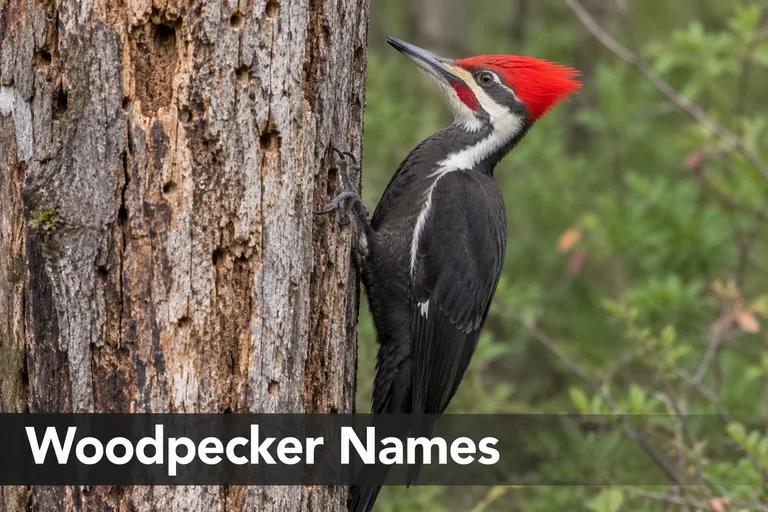
Good woodpecker names lean into what actually makes this bird different from every other backyard visitor the drumming, the zygodactyl grip, the flash of red on the crown.
Below you’ll find 300+ options grouped by real species traits, gender, personality, and humor, plus picks built specifically for pileated woodpeckers, since that’s the one most people are picturing when they search this.
What Is a Good Name for a Woodpecker?
A good woodpecker name usually points at one real, visible trait: the drumming, the red crest, the black-and-white pattern, or the way the bird works a tree trunk in short bursts. Percy, Ember, and Morse are solid starting points because they describe something you’d actually notice watching the bird, not just a random cute sound.
Skip anything too soft or drawn-out. Woodpeckers are fast, loud, and a little relentless a name with a hard consonant (Tak, Chip, Rex) tends to fit better than something long and flowing.
What Is Another Name for a Woodpecker?
Regionally, woodpeckers pick up nicknames tied to their behavior. “Sapsucker” refers to a specific group of woodpecker species that drill sap wells, not woodpeckers generally. “Log-cock” and “carpenter bird” are older folk names used in parts of the U.S. South for larger woodpeckers, especially the pileated.
None of these are formal alternate names for the whole family they’re regional shorthand, and they’re worth knowing if you want a naming angle competitors haven’t used.
What Are the Different Types of Woodpeckers?
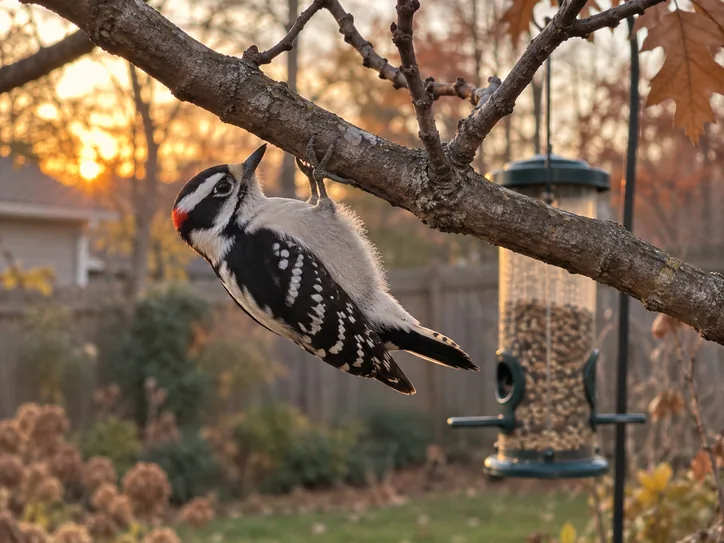
North America alone has around two dozen woodpecker species, and knowing a few real ones gives you sharper naming material than a generic “forest bird” theme. Here’s a quick reference:
| Species | Standout Trait | Naming Angle |
|---|---|---|
| Pileated Woodpecker | Crow-sized, flaming red crest, loudest drummer | Bold, commanding names |
| Downy Woodpecker | Smallest North American species, soft “pik” call | Cute, compact names |
| Hairy Woodpecker | Looks like Downy but larger, longer bill | Sturdy, no-nonsense names |
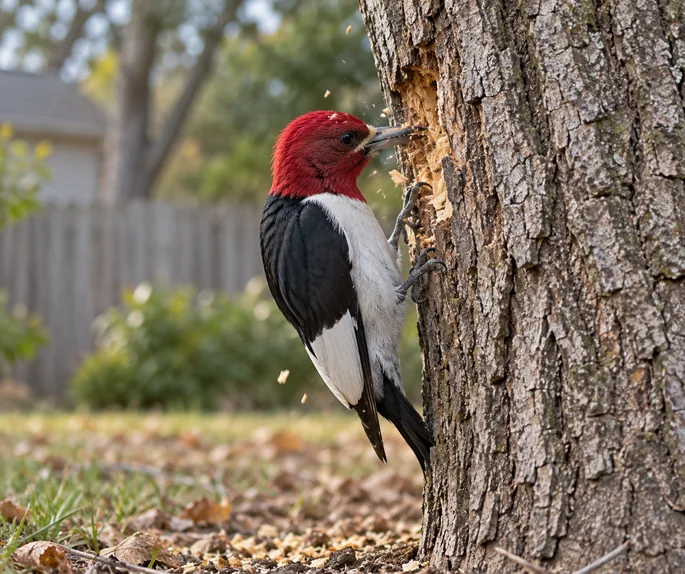
| Red-Headed Woodpecker | Fully crimson head, bold black-and-white body | Sharp, striking names |
| Northern Flicker | Ground-feeding, spotted belly, brown back | Earthy, easygoing names |
| Acorn Woodpecker | Hoards acorns in granary trees, clownish face | Playful, quirky names |
| Red-Bellied Woodpecker | Pale belly with only a faint red wash, common at feeders | Everyday, friendly names |
The pileated is the one most people mean when they picture “a woodpecker” in the wild it’s the largest species in North America, close to crow-sized, and it’s actually what the Woody Woodpecker cartoon was modeled after. It shares old-growth forest habitat with other large, territorial birds, including species covered in our eagle names guide.
How to Choose a Woodpecker Name That Actually Fits
Watch the bird or the photo, or the plan before you commit. A calm, steady tapper suits a name like Cedar or Knox far more than something built for chaos like Ricochet.
Say the name out loud a few times the way you’d actually call it. Two syllables or fewer works best if you’re naming a pet bird you’ll be calling across a room; longer names are fine for a character name or a journal entry where you’re writing it, not shouting it.
Match the name to a trait you can point to. “Because he’s got that red streak on his cheek” is a better reason to land on Blaze than “it sounded cool.” If red coloring is the main draw, our red bird names guide has more ideas built around that same trait.
Woodpecker Names Inspired by Real Species
These pull directly from actual woodpecker species names and traits, which is a naming angle most generic lists skip entirely.
- Downy – for the smallest, most delicate-looking North American woodpecker species
- Hairy – the Downy’s bigger lookalike cousin, named for its longer, straighter bill
- Flicker – Northern Flickers feed on the ground and flash yellow or red under their wings
- Sapsucker – for a bird with steady, patient habits, like the sap-well drillers of that name
- Acorn – Acorn Woodpeckers stash thousands of acorns in holes drilled into a single “granary tree”
- Lewis – after the Lewis’s Woodpecker, known for catching insects mid-air like a flycatcher
- Williamson – after the Williamson’s Sapsucker, a species with a sharply different look between male and female
- Nuttall – after a woodpecker species found mostly in California oak woodlands
- Gila – after the desert-dwelling Gila Woodpecker of the American Southwest
- Ladder – for the fine barred back pattern of the Ladder-Backed Woodpecker
Pileated Woodpecker Names
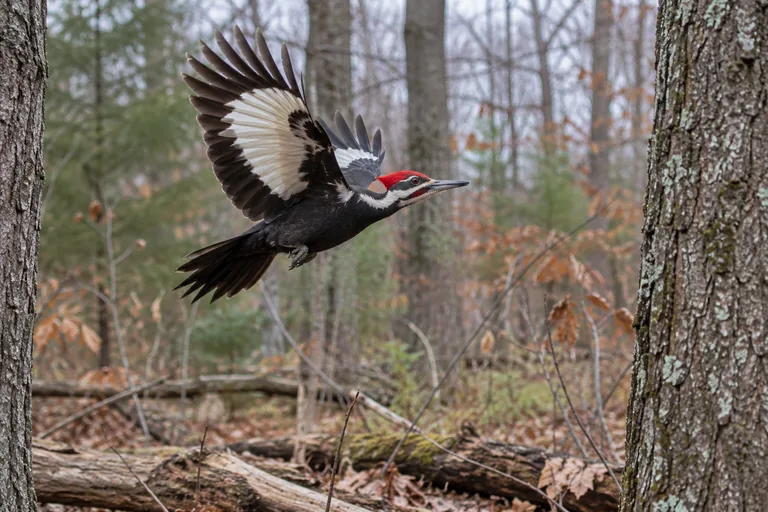
Built specifically for the biggest, boldest species the crow-sized bird with the triangular red crest that most backyard birders are actually picturing.
- Crimson Crown – the male pileated’s red runs from crest all the way to the bill
- Chief – fits the size and presence of the largest woodpecker in North America
- Timber – pileated woodpeckers favor old, dead trees big enough for deep nest cavities
- Woody – the classic, since the cartoon character was modeled on this exact species
- Ironbeak – a nod to the chisel-shaped bill strong enough to expose carpenter ant tunnels
- Cresta – a soft variation that still nods to that unmistakable red crown
- Duke – for a bird nearly the size of a crow with a presence to match
- Rattler – pileated drumming accelerates and then trails off, unlike most other species
- Ancient – these birds often reuse old-growth forest habitat other species depend on
- Sable – for the mostly black body plumage set off by white wing linings
- Talon – zygodactyl feet (two toes forward, two back) give this species a powerful tree grip
- Ember Crest – for the flame-colored feathers running along the top of the head
- Old Hammer – for the loud, resonant drumming that carries far through mature forest
- Marshal – commands the space the way this species commands a stretch of woodland
- Sequoia – pairs a big name with a big bird that needs big, old trees to nest
- Rex Pileatus – “pileatus” is Latin for “capped,” the actual root of this species’ name
- Onyx – for the near-total black body when the bird is perched and still
- Drummond – a nod to the slow, accelerating drum roll unique to this species
- Highcrown – describes the crest without guessing at a fake meaning
- Cascade – after the mountain forests where pileated populations are common
- Grandeur – for the sheer visual size difference from any other backyard woodpecker
- Loggerhead – an old folk name used regionally for larger, log-working woodpeckers
- Bishop – the pointed red crest resembles a bishop’s mitre from certain angles
- Sentinel – pileated pairs stay in a territory and defend it loudly
- Roan – for the mix of black body and warm red crown coloring
- Baron – another size-and-presence name that fits the “biggest species” angle
- Corvid Cousin – a playful nod to how close in size this species is to a crow
- Hollowmaker – pileated cavities later shelter owls, ducks, and even bats
- Redtop – simple, direct, and accurate to what you actually see first
- Old Faithful – pileated pairs are monogamous and often return to the same territory
For another bird known for a bold, oversized bill, check our toucan names guide.
Funny Woodpecker Names
Names that lean into the noise, the repetition, and the sheer commitment this bird brings to hitting wood repeatedly.
- Jackhammer – for obvious reasons if you’ve ever heard one up close
- Nutjob – because drilling a tree trunk all day is objectively a little unhinged
- Migraine – the honest reaction of anyone who’s had one drumming on their siding
- Woodrow Wilsonbeak – a mouthful, which is exactly the joke
- Percy Von Peckington – overly formal name for a bird with zero manners about noise levels
- Sir Drills-a-Lot – knighted for consistency, not restraint
- Ratatat – the actual sound, turned into a name
- Beaksplosion – for a bird that hits way above its weight class
- Splinter Cell – a video-game nod to a bird that’s basically a stealth demolition unit
- Captain Chaos – for the one that wakes the whole street up at 6 a.m.
- Buzzkill – literal, since that’s often what the drumming does to a quiet morning
- Hole-in-One – golf pun, tree-drilling edition
- The Landlord – because it makes holes other animals move into for free
- Woodzilla – oversized personality, undersized bird
- Mr. Fix-It – ironic, since it’s actually the one making the holes
- Snooze Button – the bird that ends any hope of sleeping in
- Chiselface – blunt, accurate, a little rude
- Tap Out – for when the noise finally gets to you first
- Loud Neighbor – self-explanatory to anyone who’s had one nesting nearby
- Petey Percussion – drummer-in-residence
- Knockoff Brand – for the one that sounds like it’s trying too hard
- Bark Bouncer – bouncer at the club, except the club is a dead oak
- Renovation Rick – forever “working on the house”
- Skull Crusher (Ironic) – funny precisely because the skull is what’s protected
- Sir Pecks-a-Lot – knight of relentless repetition
- Woodpeckle – silly mashup that still fits the theme
- Thud Muffin – soft name for a genuinely loud bird
- The Contractor – always mid-project, never finished
- Buzz Lightbeak – for a bird that seems to think it can drill to infinity
- Alarm Clock – nobody asked for this feature, everybody got it anyway
- Nutcracker Jr. – for the acorn-hoarding species specifically
- Peckaholic – it’s a problem at this point
- Sir Reginald Tapsworth III – aristocratic nonsense energy
- Handyman Hank – union card not included
- Tree Terrorist – affectionately, for the one demolishing your fence post
- Morse Coder – tapping out messages nobody asked to receive
- The Nuisance – said with love, mostly
- Woody McPeckface – the internet-poll energy this bird deserves
- Drill Sergeant – barks orders via percussion only
- Little Big Mouth – small bird, disproportionately loud call
- Splinterhead – for a bird that leaves debris everywhere it works
Looking for more humor-driven options? Our funny hummingbird names list takes the same approach with a very different-sized bird.
Female Woodpecker Names
Grouped around traits that are actually true for female woodpeckers in several species a shorter crest, more muted facial markings, and a quieter overall look than the males.
- Sable – for the darker, mustache-free face many females show
- Willow – soft, easy to call, fits a smaller crest
- Amber – for the warm brown forehead patch seen on female pileated woodpeckers
- Hazel – earthy and understated, matching a female’s plainer face pattern
- Fern – forest-floor imagery for a ground-feeding flicker hen
- Marigold – warm without leaning as bold as a full red crest
- Wren – short, simple, easy to call across a yard
- Juniper – evergreen-forest feel for a species that nests in old growth
- Opal – quiet shimmer instead of a bold color statement
- Sable Crest – for the shorter, less extensive crest females typically carry
- Reed – slim and understated
- Cinder – soft grey-black tones without the male’s red mustache mark
- Dove – gentler cousin energy, even though they’re unrelated species
- Maple – warm bark-brown tones
- Sienna – for the reddish-brown wash on some female markings
- Birdie – simple, affectionate, no frills
- Autumn – for the muted, earthier palette many females carry
- Coral – a small pop of warmth without overstating it
- Ivy – climbing, gripping, tree-hugging imagery
- Piper – active and light on her feet along a branch
- Sparrow – borrowed smallness for a compact-bodied hen
- Thistle – textured, a little prickly, memorable
- Bramble – forest-undergrowth energy
- Ginger – warm reddish-brown tones
- Meadow – open, easy, unforced
- Clover – simple luck-charm name with a nature root
- Sage – calm, steady, grounded
- Rowan – tree-named, gender-neutral leaning female here
- Petal – soft contrast to the bird’s actual toughness
- Fable – for a bird you’ll end up telling stories about anyway
- Talia – light, easy to call
- Nova – bright without being loud
- Elowen – Cornish-origin name meaning “elm tree,” a real fit for a tree-dwelling bird
- Robin – borrowed backyard-bird familiarity
- Marlowe – sleek, a little literary
- Zinnia – bright garden-flower energy
- Suri – short, easy, a little sharp
- Faye – small and quick
- Skye – open, airy, easy to call
- Wisp – for how fast females move between trunk sections
Male Woodpecker Names
Built around the traits actually specific to males in several species the red mustache stripe, the fully red crown, and the louder territorial drumming.
- Rex – Latin for “king,” a fitting root for the bird with the boldest crown
- Blaze – for the red streak running down a male pileated’s cheek
- Duke – size and swagger, especially for larger species
- Chief – territorial, loud, unmistakably in charge
- Rusty – for reddish tones on species like the red-headed woodpecker
- Talon – the zygodactyl grip that lets this bird cling sideways to bark
- Hank – blunt, easy, workmanlike
- Gunner – rapid-fire drumming energy
- Bruiser – for a bird that hits wood harder than its size suggests
- Axel – sharp-sounding, matches a chisel-shaped bill
- Knox – short, hard-edged, easy to call
- Sonny – warm and familiar
- Bolt – fast, direct movement between trunks
- Rocco – tough-sounding without trying too hard
- Diesel – for the sheer stamina behind repeated drumming bouts
- Fitzgerald – for a bird with an oddly formal presence
- Ozzy – loud, a little chaotic, memorable
- Crimson – straightforward nod to the red crest and mustache
- Woody – the obvious pick, and still a solid one
- Percy – old-fashioned, a little dignified
- Griff – sharp, short, easy to shout
- Chisel – literal nod to the bill shape
- Zeke – quick and casual
- Copper – for the warm reddish tones on several species
- Otis – old-school charm
- Ranger – forest-dwelling, territory-holding energy
- Beckett – literary, a little sharp-edged
- Maverick – for a bird that doesn’t hold back
- Wyatt – rugged, plain-spoken
- Ridge – for a bird found in mountain and ridge forests
- Ash – tree-rooted, understated
- Bramwell – old-fashioned and forest-adjacent
- Sterling – sharp, a little sleek
- Marlon – smooth-sounding contrast to a rough job
- Cassius – bold and a little theatrical
- Ferris – quick, light, easy on the tongue
- Huxley – literary and sharp
- Baron – for size and presence, echoing the pileated angle
- Grit – for a bird that works through hard wood daily
- Torch – another nod to that flame-red crest
Baby Woodpecker Names
Young woodpeckers called hatchlings or nestlings, not chicks specifically are bald and pink at first, then grow soft, fuzzy plumage before fledging.
- Pip – classic small-bird name, easy for a nestling
- Bean – small and round, matching an early hatchling’s shape
- Dot – tiny, simple, easy to call
- Nubbin – playful nod to how small the crest looks at first
- Pebble – small and grounded
- Squirt – for the smallest one in the nest
- Peanut – classic small-and-cute pick
- Bud – early-growth imagery, still forming
- Twig – small and easily overlooked, like a hatchling in a cavity
- Dash – short and quick, fitting a fast-fledging bird
- Tiny Tap – a gentler, quieter version of the adult drumming sound
- Sprout – growing-and-new energy
- Nibble – small bites, small bird
- Chip – short for chipmunk-sized, or just a fitting short name
- Fig – small, round, easy to say
- Sprig – young branch imagery
- Blip – barely there yet, but growing fast
- Wisp – for the first soft down feathers
- Puff – early, fluffy plumage before feathers fill in
- Nook – for the tree cavity a hatchling starts life in
- Scoot – for a nestling that’s already restless
- Tater – round and unformed, in a good way
- Munchkin – classic small-and-cute
- Fledge – literal nod to the stage right before leaving the nest
- Cricket – small and quick
- Speck – barely visible against the tree bark
- Dabble – still learning to peck properly
- Little Tap – softer cousin of “Tiny Tap”
- Cub – borrowed from mammal naming, still fits a young bird
- Newling – simple, descriptive, a little sweet
Cool and Drumming-Inspired Woodpecker Names
Built around the actual sound and rhythm of a woodpecker at work, since drumming is the trait most people notice before they ever see the bird.
- Morse – for the rhythmic, code-like pattern of a drumming bout
- Ricochet – fast, bouncing, unpredictable
- Echo – for how far a drum roll carries through open forest
- Static – rapid-fire and a little chaotic
- Pulse – steady rhythm, easy to picture
- Vortex – for a bird that seems to spin around a trunk while feeding
- Cipher – another nod to the coded-sounding drum pattern
- Rattlebeak – blunt and accurate
- Strobe – fast, flickering movement between branches
- Kinetic – constant motion, constant energy
- Ricochet Jr. – for a smaller, quicker species
- Volt – electric energy in a small package
- Cadence – the actual rhythm pattern of repeated drumming
- Static Cling – for a bird that locks onto a trunk and doesn’t let go
- Nomad – some species range widely between feeding trees
- Circuit – for a bird that works a set pattern around a trunk
- Riff – musical, matching the drumbeat comparison
- Tempo – speed and rhythm in one word
- Sonic – fast and a little over the top
- Drift – for gliding flight between trees
- Zephyr – light, quick wingbeats
- Comet – fast, bright, hard to miss
- Nitro – all-in energy
- Flux – constant change in position and sound
- Quill – sharp and precise
- Ratchet – mechanical, repetitive, fitting
- Beat – the simplest, most direct drumming reference
- Loop – for a bird that works a trunk in repeated circuits
- Signal – drumming as communication, which it actually is
- Static Beak – playful mashup of sound and body part
Woodpecker Names by Color and Marking
Grounded in the real color patterns you’d actually see, not invented meanings.
- Onyx – for solid black body plumage on species like the pileated
- Ivory – for pale bill or wing-lining coloration
- Crimson – direct nod to red crest or crown feathers
- Ash – grey-toned plumage seen on several smaller species
- Coal – deep black, no gloss implied
- Snowline – for the white wing-lining pattern visible in flight
- Goldwing – for the yellow underwing shafts on Northern Flickers
- Barkstripe – for horizontal black-and-white facial striping
- Charcoal – muted dark grey-black
- Frost – pale, cool-toned plumage
- Scarlet – bold, saturated red
- Slate – flat blue-grey tone
- Cream – pale belly coloring seen on species like the red-bellied woodpecker
- Ember – warm, glowing red without overclaiming meaning
- Pearl – soft, pale highlight tones
- Rust – muted orange-brown seen on several species’ underparts
- Chalk – flat white marking
- Copperhead – reddish crown coloring
- Umber – deep brown, earthy tone
- Flame – another direct nod to bright red crest coloring
- Marble – mixed black-and-white patterning
- Auburn – warm reddish-brown
- Storm – dark grey plumage, moody without being fake-mystical
- Blush – a lighter pink-red wash on some markings
- Sable Stripe – dark facial striping
- Sandstone – tan-brown tones on desert species like the Gila Woodpecker
- Cocoa – warm brown body tones
- Alabaster – pale, almost white patches
- Vermilion – a specific, accurate red-orange shade
- Graphite – dark grey, precise and modern-sounding
Woodpecker Nicknames
Short, easy calls for everyday use the kind a real owner or backyard birder actually shouts across a yard.
- Woody – the obvious, still-solid classic
- Peck – shortest possible version of the behavior itself
- Tap – one syllable, easy to call
- Drummer – simple and accurate
- Chip – quick and casual
- Beaky – affectionate, a little silly
- Buzzer – for the sound carrying across a yard
- Knock – literal and blunt
- Tick – for a lighter, quicker tapping style
- Thump – for a heavier hit
- Rap – short for the rhythm, not the music genre
- Bonk – silly, kid-friendly
- Nailer – workmanlike shorthand
- Rattle – for the accelerating drum pattern
- Perch – for time spent gripping bark
- Bark – short for its favorite work surface
- Hollow – for the cavity-nesting habit
- Ridge – short, forest-rooted
- Notch – for the distinct rectangular holes some species leave
- Grip – for that zygodactyl toe arrangement
Woodpecker Names Inspired by Personality and Behavior
For the trait people notice after watching the bird a while, not just the first glance.
- Patience – some species feed in one spot for long stretches
- Scout – always checking a new section of bark
- Ranger – territorial, forest-based, always on patrol
- Forager – direct nod to the constant insect-hunting behavior
- Nomad – for species that range widely between feeding sites
- Sentry – alert, watchful, quick to call out an alarm
- Precision – for the accuracy of a well-aimed strike
- Restless – rarely still for long
- Steady – for the slow, methodical feeders
- Determined – it takes real commitment to drill through solid wood
- Curious – investigates every new trunk it lands on
- Bold – unbothered by being watched at close range
- Watchful – alert to predators while feeding
- Industrious – always mid-task, rarely idle
- Territorial – defends a feeding or nesting range loudly
- Vigilant – for the sharp alarm call many species give
- Focused – tunnel vision, literally, while excavating
- Resourceful – reuses old cavities, finds food others miss
- Agile – quick, precise movement along vertical bark
- Tenacious – doesn’t quit until the job’s done
- Sharp-Eyed – spots insect movement under bark from a distance
- Methodical – works a trunk in a set, repeatable pattern
- Alert – first to notice movement nearby
- Adaptive – several species thrive near cities and parks now
- Independent – forages solo outside of breeding season
- Steadfast – returns to the same nesting territory year after year
- Observant – notices insect activity long before striking
- Driven – matches the sheer repetition of daily drumming
- Quick-Witted – reacts fast to competing birds at a feeder
- Grounded – for ground-feeding species like the Northern Flicker
Common Mistakes to Avoid When Naming a Woodpecker
Don’t pick a name based on a made-up “meaning” or foreign-language translation you found on a random list a lot of woodpecker name lists online invent etymologies that don’t hold up. Stick to names tied to something real: the species, the color, the sound, or the behavior.
Skip anything too long if you’ll be calling the name out loud regularly. A three-syllable name sounds fine written down and gets clipped into something else within a week anyway.
Don’t assume male and female naming traits apply the same way across every species the red-mustache, bigger-crest pattern is specific to a handful of species like the pileated, not a universal woodpecker rule.
Final Thoughts on Naming Your Woodpecker
The best woodpecker name usually comes from watching the bird do something specific the way it grips bark sideways, the rhythm of a drum roll, that flash of red when it turns its head. Pick a name that means something to you when you say it, and it’ll stick a lot longer than whatever sounded catchiest on a list.
If you’re naming other backyard or forest birds too, our hawk names guide covers a similarly bold, territorial bird, and the owl names list leans into another species that shares the same old-growth forest habitat.
FAQ
A good woodpecker name usually points at a real trait the drumming, the red crest, or the black-and-white pattern rather than a random cute word. Names like Ember, Percy, or Morse work because they describe something you’d actually notice watching the bird.
“Log-cock” and “carpenter bird” are older regional folk names used for larger woodpeckers, especially the pileated. “Sapsucker” refers to a specific group of species that drill sap wells, not woodpeckers as a whole.
North America has around two dozen species, including the Pileated, Downy, Hairy, Red-Headed, Northern Flicker, Acorn, and Red-Bellied Woodpecker. Each has a distinct size, color pattern, and feeding habit worth naming around.
The Pileated Woodpecker is the largest living woodpecker species in North America, close to crow-sized, with a wingspan between roughly 26 and 29.5 inches.
Woodpeckers drum and drill to find insects like carpenter ants hidden under bark, to excavate nesting cavities, and to send territorial or mating signals to other woodpeckers. The three behaviors sound similar but serve different purposes.