
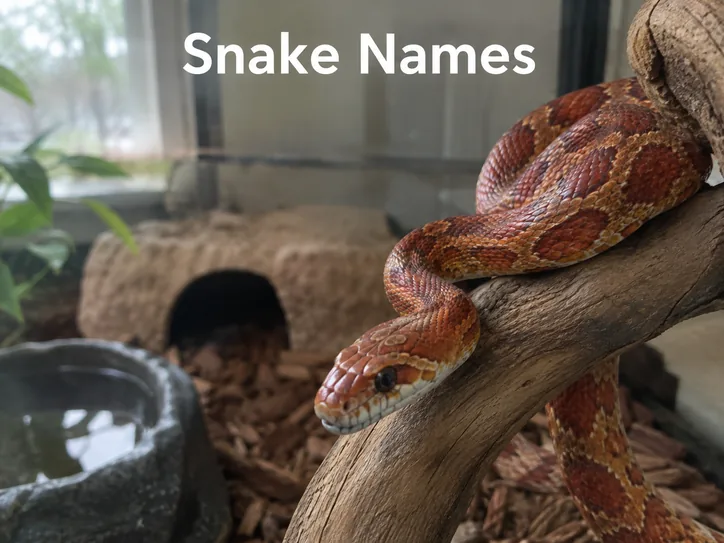
Snake names work best when they’re tied to something real about the animal in front of you: its color, its species, how it acts when you open the enclosure. Below are 400+ options grouped by sex, pattern, species, myth, and pop culture, plus the naming mistakes owners make in the first week and how to sidestep them.
We brought home a ball python on a Tuesday and spent three days calling her “the snake” because nothing felt right. Then she flattened herself against the glass every time the heat lamp clicked on, sunning like she owned the place, and Sunny stuck. That’s usually how it goes the name shows up once you’ve actually watched the animal for a few days, not before.
Quick Navigation: How These Names Are Grouped
- Female Snake Names — for a confirmed female or a snake you’re calling “she”
- Male Snake Names — for a confirmed male or a snake you’re calling “he”
- Standout Picks: Best Snake Names — a comparison table of the names that work across nearly any species
- Black Snake Names — for melanistic morphs, black kingsnakes, black rat snakes
- White Snake Names — for albino, leucistic, and pied-white morphs
- Ball Python Snake Names — matched to morph coloring and the ball-up habit
- Red Corn Snake Names — for classic red corns and amelanistic morphs
- Mythical Snake Names — serpent gods, demons, and legendary beasts
- Kill Bill Snake Names — the Deadly Viper Assassination Squad’s snake-species code names
- Venomous Snake Names — real venomous-species names as inspiration for a non-venomous pet
- Cool Snake Names — sleek, sharp, one-syllable options
- Funny Snake Names — puns and personality-driven picks
How to Choose a Snake Name That Actually Fits
Watch the snake for a few days before committing. A corn snake that spends every afternoon pressed against the glass acts nothing like one that burrows the second you open the lid, and the name should match the one you actually have.
Say the name out loud at feeding time. Short, one-or-two-syllable names cut through faster than anything with three-plus syllables, which matters if you’re calling a name across the room to a partner or a kid.
Match the name to what won’t change. A snake’s morph coloring is permanent; a “shy” phase after a move to a new enclosure often isn’t. Pick names tied to pattern, species, or sex over a mood you’ve only seen for a week.
Female Snake Names
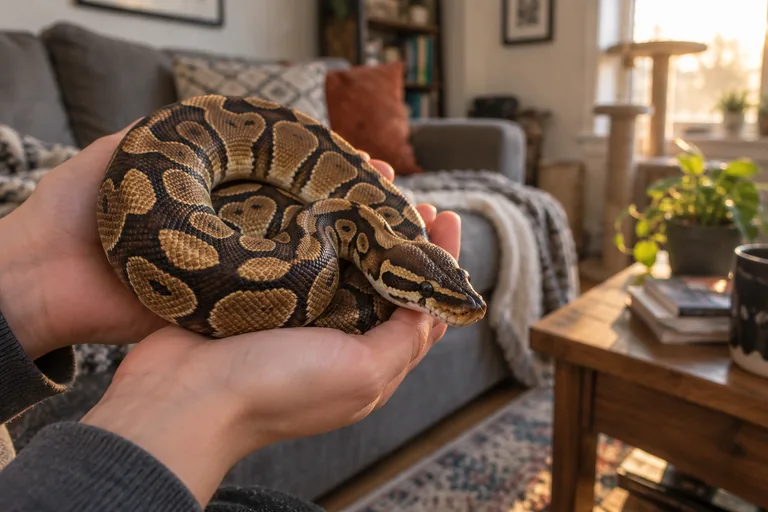
These work for a confirmed female or any snake you’re already calling “she.” A handful lean toward serpent goddesses and queens; most are just names that sound right on a female snake regardless of species.
- Aria – light, musical, and short enough to say fast at feeding time.
- Cleo – short for Cleopatra, the Egyptian queen said to have died from an asp bite.
- Delphine – French for “dolphin,” but the flowing sound suits a smooth-scaled female.
- Freya – Norse goddess of love and war, a strong pick for a confident female.
- Gwen – Welsh for “white, fair,” a clean fit for a pale-scaled female.
- Hazel – for a female with warm brown or amber-toned scales.
- Indie – short, modern, works on almost any female snake.
- Ivy – a climbing plant name for a female that likes to explore branches.
- Jinx – for a female with an unpredictable streak.
- Kaida – Japanese-inspired, meaning “little dragon.”
- Layla – Arabic for “night,” a fit for a dark-scaled female.
- Mave – from Irish queen Maeve, meaning “she who intoxicates.”
- Nova – Latin for “new,” a bright choice for a striking female.
- Opal – for a female with iridescent or pearly scale sheen.
- Persia – exotic-sounding, pairs well with jewel-toned females.
- Quill – short and a little sharp, works for a feisty female.
- Ruby – a warm red gemstone name for a red-toned female.
- Sable – for a dark, almost black female.
- Talia – Hebrew for “dew from heaven,” soft and short.
- Uma – Sanskrit for “flax, light,” short and easy to call.
- Vesper – Latin for “evening,” a fit for a dusky-scaled female.
- Willow – for a slender, flexible female that loves to stretch.
- Xara – a modern variant of Zara, meaning “princess.”
- Yara – Arabic for “small butterfly,” light and quick like some smaller females.
- Zola – short, strong, and a little unexpected.
- Amara – means “eternal” in several African and Sanskrit-rooted languages.
- Bree – short for Sabrina or Bridget, easy and casual.
- Coral – for a female with reddish-orange banding.
- Dahlia – a bold flower name for a female with striking pattern.
- Esme – French-derived, meaning “esteemed” or “loved.”
- Faye – Old English for “fairy,” short and quiet-sounding.
- Giselle – graceful, ballet-adjacent, fits a smooth mover.
- Harlow – a modern, slightly edgy pick for a bold female.
- Iris – Greek goddess of the rainbow, good for multicolored morphs.
- Juno – Roman queen of the gods, commanding and short.
- Kira – means “light” in several Slavic languages.
- Luna – Latin for “moon,” a classic fit for a pale or silver female.
- Marlowe – literary-sounding, unisex-leaning but reads female here.
- Nyla – means “champion” or “winner” in Arabic-rooted use.
- Ondine – French water-spirit name, fits a female that loves soaking.
- Petra – Greek for “rock,” steady and grounded-sounding.
- Quinn – Irish-rooted, means “wise” or “counsel,” short and unisex-leaning.
- Rhea – a Greek titan goddess name, also the name of a large flightless bird.
- Sana – Arabic for “brilliance” or “radiance.”
- Tamsin – a softened form of Thomasina, uncommon and gentle-sounding.
- Una – Latin for “one,” short and clean.
- Vera – Russian-rooted, means “faith.”
- Wilhelmina – shortens well to “Willa,” strong and a little old-fashioned.
- Xiomara – Spanish-rooted, means “ready for battle.”
- Yolanda – Greek-rooted, means “violet flower.”
- Zinnia – a bold, brightly colored flower name.
- Briar – for a female with a sharp, defensive streak.
- Calla – a flower name, elegant and short.
- Della – simple, warm, easy to call.
- Elowen – Cornish for “elm tree,” uncommon and pretty.
- Fern – a plant name, quiet and grounded.
Male Snake Names
Male names skew a little harder-edged here, though plenty double as unisex. Pick one that matches temperament as much as sex a mellow corn snake wears “Diesel” about as well as a hyperactive one wears “Monk.”
- Ash – short, works for gray or black-scaled males.
- Blaze – for a male with a bold orange or red stripe.
- Cyrus – Persian-rooted, means “sun” or “throne.”
- Diesel – blunt, punchy, good for a heavy-bodied male like a boa.
- Ezra – Hebrew for “help,” short and easy to call.
- Finn – Irish for “fair,” works for pale males.
- Grim – for a dark, moody-looking male.
- Hugo – German-rooted, means “mind, intellect.”
- Ike – short, strong, works on nearly any male snake.
- Jax – modern, sharp-sounding, good for an alert male.
- Kilo – military-alphabet-style, blunt and easy to say.
- Leo – Latin for “lion,” bold despite the mismatch in species.
- Milo – soft-sounding, fits a calmer, easygoing male.
- Nash – short, a little rugged.
- Orion – the hunter constellation, fitting for a predatory male.
- Pike – sharp and short, works for a lean-bodied male.
- Quill – doubles here for a male with a sharp personality.
- Rex – Latin for “king,” classic and blunt.
- Silas – Latin-rooted, means “of the forest.”
- Talon – for a male that strikes fast at feeding time.
- Ulric – Old German for “wolf power,” a strong pick for a bold male.
- Vance – short, modern, unisex-leaning but common on males.
- Wren – technically a bird name, but short and clean on a male snake.
- Xander – short for Alexander, “defender of men.”
- York – blunt, geographic, easy to say fast.
- Zeke – short for Ezekiel, punchy and casual.
- Atlas – Greek titan who held up the sky, fits a large-bodied male.
- Bishop – chess-piece name, works for a calm, deliberate male.
- Cain – short, biblical, a little dark.
- Duke – blunt title name, fits a confident male.
- Ellis – soft consonant sound, works for a mellow male.
- Flint – for a gray or dark-scaled male.
- Griff – short for Griffin, sharp-sounding.
- Hollis – uncommon, has a slight old-world feel.
- Igor – classic monster-movie name, playful on a snake.
- Jett – for a fast-moving or jet-black male.
- Knox – blunt, one-syllable, easy to call.
- Locke – short, a little mysterious.
- Magnus – Latin for “great,” a strong choice for a big male.
- Ozzy – casual, a little rock-and-roll.
- Perseus – the Greek hero famous for defeating Medusa, a pointed pick for a snake.
- Quentin – Latin-rooted, means “fifth,” steady and classic.
- Roman – blunt, historical, easy to say.
- Sterling – means “high quality,” works for a silvery-scaled male.
- Titus – Roman-rooted, means “of the giants,” fits a large-bodied male.
- Ulysses – the wandering hero of Greek epic, long journey energy for an active male.
- Victor – Latin for “conqueror,” blunt and classic.
- Wolfgang – German-rooted, “wolf path,” a mouthful but distinctive.
- Xerxes – a Persian king’s name, bold and uncommon.
- Yusuf – Arabic form of Joseph, soft-sounding and short.
- Zorro – Spanish for “fox,” playful and sharp.
- Brutus – Roman-rooted, blunt and a little intimidating.
- Caspian – named after the sea, works for a blue-gray-toned male.
- Dorian – Greek-rooted, literary-sounding.
- Emrys – Welsh form of Ambrose, means “immortal.”
- Falkor – playful, dragon-adjacent sound without naming a specific property.
Standout Picks: Best Snake Names
Some names just work across nearly any species, sex, or color, because they’re built around behavior instead of a specific trait. These are the ones we’d reach for first if we couldn’t decide.
| Name | Meaning or Fit | Best For |
|---|---|---|
| Noodle | Simple description of a snake’s shape | Any species, especially skinny colubrids |
| Monty | Nods to the “Monty Python” comedy troupe | Any python species |
| Slink | Describes the low, smooth way snakes move | Any species that moves a lot at night |
| Echo | Short, clean, works said aloud or shouted | Any confident, alert snake |
| Sable | Means a dark, rich black | Melanistic or dark-scaled snakes |
| Ziggy | Playful, easy to say, no wrong fit | Younger or more active snakes |
| Bandit | Fits a snake with a masked or banded face pattern | Kingsnakes, milk snakes |
| Ember | Warm, glowing color reference | Red, orange, or amber-toned snakes |
| Storm | Fits an unpredictable or fast-striking snake | Bold or defensive individuals |
| Rune | Nods to old carved symbols, feels mysterious | Patterned or marked snakes |
Black Snake Names
Black-scaled snakes melanistic morphs, black rat snakes, Mexican black kingsnakes carry a naming logic all their own. Owners tend to lean into the depth of the color itself rather than forcing a generic name onto it.
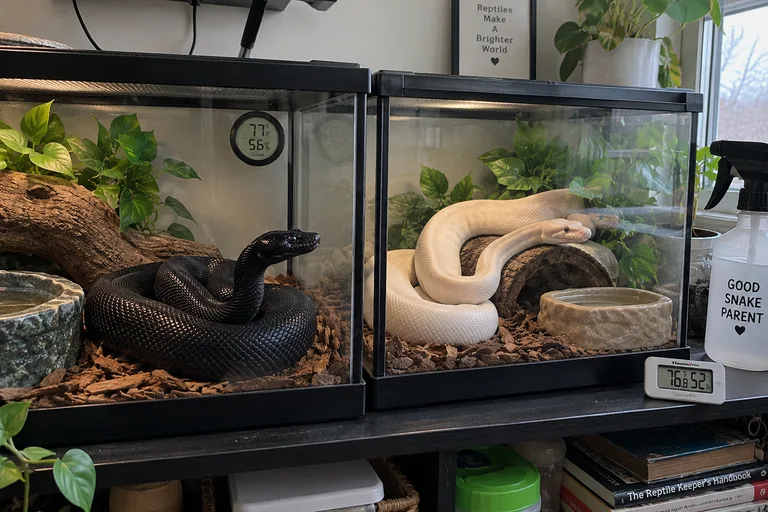
Real black-coated animals get compared to obsidian, coal, and ink across most naming traditions, and that logic holds here too: a true glossy black snake reads differently under light than a plain dark gray one, closer to wet stone than flat charcoal.
- Onyx – a black gemstone, direct and fitting.
- Coal – blunt, dark, easy to picture.
- Raven – named after the black bird, works for a sleek black snake.
- Midnight – for the deepest black scales.
- Jet – another black gemstone reference, short and sharp.
- Shadow – classic, fits a snake that seems to disappear against dark backgrounds.
- Ink – simple, wet-looking black.
- Vantablack – a nod to the famously light-absorbing material, playful for an especially dark snake.
- Panther – borrows from the big cat’s black coat.
- Charcoal – slightly softer than pure black, fits a matte-scaled snake.
- Noir – French for “black,” a little stylish.
- Ebony – a dense black wood, classic and warm-sounding.
- Licorice – food-based, playful, still reads as black.
- Smoke – for a black snake with a slightly hazy sheen.
- Cinder – the leftover ash from a fire, dark and textured.
- Blackjack – card-game reference, punchy.
- Domino – for a black snake with small white or cream markings.
- Tar – blunt, thick, sticky-black.
- Widow – borrows from the black widow spider’s reputation.
- Vader – a nod to the classic dark-cloaked villain archetype, used generically here without naming the franchise.
- Grimm – dark, fairy-tale-adjacent.
- Soot – light, casual, still clearly black.
- Eclipse – for the moment black fully covers light.
- Basalt – a dark volcanic rock.
- Crow – another black bird reference, short and sharp.
- Pitch – as in pitch-black, blunt and simple.
- Slate – technically gray-black, works for a slightly lighter individual.
- Mamba – borrows the name of the famously fast black-bodied venomous species as inspiration, not a claim of relation.
- Ninja – playful, leans into stealth.
- Void – for a snake that looks like it swallows light.
White Snake Names
White and near-white morphs albino, leucistic, pied need names that don’t just say “white” over and over. The best ones borrow from snow, pearl, and pale stone instead.
- Snow – the most direct, still works because it’s accurate.
- Pearl – for scales with a soft sheen rather than flat white.
- Frost – cool, crisp, fits a pale morph well.
- Ghost – common in the reptile hobby for pale or leucistic snakes.
- Ivory – a warmer white than “Snow,” slightly cream-toned.
- Cotton – soft, textured, casual.
- Alabaster – a pale, fine-grained stone, elegant option.
- Marshmallow – playful, works especially well on rounder-bodied species.
- Casper – a nod to the classic friendly-ghost archetype, playful and short.
- Blizzard – for a fast-moving pale snake.
- Opal – gemstone with a milky-white base and shifting sheen.
- Milk – blunt and simple, also nods to milk snakes if that’s the species.
- Cream – softer than pure white, works on off-white morphs.
- Salt – short, blunt, pairs well with “Pepper” for a two-snake household.
- Chalk – matte and pale, less glossy than “Pearl.”
- Vanilla – warm, food-based, casual.
- Diamond – for a bright, high-shine white morph.
- Angel – leans into the pale, gentle read of a white snake.
- Winter – seasonal, cool-toned.
- Halo – soft light reference, works for pale morphs with subtle color rings.
- Bianca – Italian for “white,” elegant option for a female.
- Blanco – Spanish for “white,” short and direct.
- Luna – doubles here for a pale, moon-colored snake.
- Glacier – a huge slow-moving mass of pale ice.
- Powder – as in powder-white, soft and light.
- Moonstone – a pale, glowing gemstone.
- Sugar – sweet, casual, food-based.
- Ash – doubles here for a light gray-white individual.
- Cloud – soft and drifting.
- Marble – for a white morph with faint gray or cream veining.
- Star – simple, bright, versatile.
Ball Python Snake Names
Ball pythons come in dozens of named morphs, and the best names for them usually match the specific color palette of the individual snake rather than the species in general. This list leans warm, curling, and food-adjacent, since ball pythons are famous for coiling into a tight ball when startled.
- Biscuit – for warm tan and golden morphs.
- Coilby – a pun on the coiling habit that gives the species its name.
- Toffee – fits banana or caramel-toned morphs.
- Mochi – soft-sounding, works for a gentle, curl-loving individual.
- Orbit – nods to the tight circular coil shape.
- Pretzel – twisty and food-based, a hobby favorite.
- Nutmeg – for brown and cinnamon-toned morphs.
- Copper – metallic and warm.
- Dune – earthy, sand-toned, fits desert-colored morphs.
- Fig – short and a little sweet, works on smaller individuals.
- Maple – woodsy and warm.
- Cocoa – another warm-brown food reference.
- Whorl – describes the spiral shape of a coiled python.
- Amber – for honey-toned morphs.
- Bourbon – rich, amber, smooth.
- Clove – a spice reference for darker, reddish-brown morphs.
- Hazel – doubles here for warm-eyed or warm-scaled individuals.
- Latte – café-toned, casual and warm.
- Pecan – another warm nut-brown reference.
- Truffle – dark and earthy.
- Ginger – spicy and reddish.
- Toasty – casual, warm-toned, playful.
- Butterscotch – for golden-brown morphs.
- Praline – another sweet, warm-brown food name.
- Cinnamon – a classic warm-red-brown spice reference.
- Mocha – coffee-and-chocolate blend, warm-toned.
- Sienna – an earthy reddish-brown pigment name.
- Umber – another earth-toned pigment name, slightly darker than sienna.
- Roll – short for cinnamon roll, playful and warm.
- Sable – doubles here for the darker end of ball python morphs.
Red Corn Snake Names
Classic red corn snakes and amelanistic morphs carry some of the boldest natural coloring in the pet trade a mix of orange-red saddles on a lighter background. Names here lean into fire, spice, and warm fruit rather than repeating “Red” over and over.
- Ember – for the glowing look of a red corn’s saddled pattern.
- Blaze – doubles here for a corn snake specifically.
- Cayenne – a spicy pepper reference, fits the warm tone well.
- Paprika – another spice-based red-orange name.
- Maize – corn snakes are named for their resemblance to Indian corn, and this leans directly into that.
- Marigold – an orange-red flower reference.
- Rust – for a slightly deeper, more oxidized red tone.
- Tabasco – a spicy sauce reference, playful and warm.
- Cherry – simple, fruit-based, direct.
- Cinnamon – doubles here on a corn snake specifically.
- Scarlet – a bright, slightly orange-leaning red.
- Salsa – food-based, playful, fits a lively individual.
- Poppy – a red flower name, short and bright.
- Autumn – seasonal, leans into fall foliage tones.
- Fireside – warm and glowing.
- Cardinal – named after the bright red bird.
- Terracotta – an earthy reddish-orange clay color.
- Sunset – a wide-ranging warm color reference.
- Copperhead – borrows a real North American species’ name for the color association only, not a claim of relation.
- Garnet – a deep red gemstone.
- Salmon – for a paler pink-orange corn snake.
- Mango – a warm orange-red fruit reference.
- Brick – blunt and earthy.
- Chili – short, spicy, playful.
- Foxglove – a reddish flower name with a slightly wild edge.
- Rooibos – a reddish tea, uncommon and distinctive.
- Candy Corn – nods to the corn snake’s namesake pattern directly.
- Torch – bright, glowing, direct.
- Adobe – another warm clay-red reference.
- Sriracha – playful, spicy, modern.
Mythical Snake Names
Serpents show up across nearly every mythology on earth, usually as gods, guardians, or world-ending monsters. These names carry weight, so they suit a snake with a bold pattern or a commanding presence.
- Medusa – the Gorgon of Greek myth whose hair was made of snakes.
- Jörmungandr – the world-serpent of Norse legend, said to encircle the earth.
- Apep – an ancient Egyptian serpent deity associated with chaos and darkness.
- Quetzalcoatl – the feathered serpent god of Aztec and broader Mesoamerican myth.
- Naga – the general term for serpent deities across Hindu and Buddhist tradition.
- Vasuki – a serpent king from Hindu mythology, often shown wrapped around the god Shiva.
- Basilisk – the legendary serpent said to kill with a glance.
- Hydra – the multi-headed serpent of Greek myth defeated by Hercules.
- Ouroboros – the ancient symbol of a serpent eating its own tail, representing cycles.
- Wadjet – an Egyptian cobra goddess whose name means “the green one.”
- Tiamat – a Babylonian sea-serpent goddess linked to primordial chaos.
- Fafnir – a dwarf-turned-serpent from Norse legend, guarding a hoard of treasure.
- Kaliya – a many-headed serpent from Hindu mythology said to live in a sacred river.
- Leviathan – a massive sea serpent referenced in biblical text.
- Coatlicue – an Aztec mother goddess associated with serpent imagery.
- Nüwa – a creator figure in Chinese mythology, often shown with a serpent’s lower body.
- Echidna – called the “mother of monsters” in Greek myth, half woman and half serpent.
- Glycon – a snake deity worshipped in the Roman Empire.
- Asclepius – the Greek god of medicine, whose serpent-wrapped staff is still a medical symbol today.
- Nidhogg – a dragon-like serpent from Norse legend whose name roughly means “dread biter.”
- Manasa – a Hindu goddess associated with snakes and protection from venom.
- Melusine – a serpent-tailed spirit from European folklore.
- Uraeus – the upright cobra symbol worn on the crowns of Egyptian pharaohs.
- Shesha – the cosmic serpent of Hindu myth, said to support the universe.
- Cerastes – named for the horned viper of Greek and Roman legend.
- Draco – the Latin word for dragon or serpent, short and strong.
- Zilant – a legendary serpent-dragon figure from Tatar folklore.
- Bai Suzhen – a powerful white-snake spirit from Chinese legend.
- Selene – not a serpent figure herself, but the Greek moon goddess, a common pairing for pale snakes in myth-themed households.
- Nyx – the Greek goddess of night, a fitting match for a dark-scaled mythic name.
- Gorgon – the broader term for Medusa’s snake-haired sisterhood.
- Ophion – the primordial serpent said in Greek myth to have incubated the world egg.
- Chnoubis – a serpent deity from Gnostic and Greco-Egyptian tradition.
- Titan – for the giant pre-Olympian gods of Greek myth, fitting a large-bodied snake.
- Azrael – the angel of death across several traditions, dark and weighty.
- Lilith – a figure from Mesopotamian and later folklore, often linked to serpent imagery.
- Set – the Egyptian god associated with chaos, sometimes depicted alongside serpents.
- Hecate – the Greek goddess of magic and crossroads, occasionally shown with serpent imagery.
- Loki – the Norse trickster god, associated in some myths with serpent transformations.
- Kundalini – a Sanskrit term describing coiled serpent energy in yogic tradition.
- Sekhmet – an Egyptian lioness goddess sometimes paired with serpent-guardian myths.
- Python – named after the serpent guardian of Delphi in Greek myth, slain by Apollo.
- Amphisbaena – a two-headed serpent from Greek and Roman legend.
- Nehebkau – an Egyptian serpent deity linked to protection and the afterlife.
- Meretseger – an Egyptian cobra goddess whose name means “she who loves silence.”
Kill Bill Snake Names
Not affiliated with Miramax, Lionsgate, or Quentin Tarantino these are the real snake species used as code names for the Deadly Viper Assassination Squad in the “Kill Bill” films, used here purely as naming inspiration.
The squad’s code names are all genuine venomous snake species, which makes this list double as a real-species primer as much as a movie reference.
- Black Mamba – the lead assassin’s code name, and one of the fastest, most feared venomous snakes in Africa.
- Cottonmouth – named for the semi-aquatic North American pit viper known for the pale lining of its mouth.
- Copperhead – a common North American pit viper known for its coppery, hourglass-banded pattern.
- California Mountain Snake – based on the California mountain kingsnake, a nonvenomous species known for bold banding.
- Sidewinder – a small rattlesnake species named for its unique sideways movement across loose sand.
Venomous Snake Names
These borrow the names of real venomous species purely as naming inspiration for a pet snake most pet snakes, including every corn snake, ball python, and kingsnake, aren’t venomous at all. The names work because they carry a reputation the actual pattern or attitude can live up to.
- Viper – the broad family name for a huge group of venomous snakes worldwide.
- Cobra – evokes the hooded, upright defensive stance of true cobras.
- Adder – the common name for Europe’s only native venomous snake.
- Asp – an old term historically used for Egyptian cobras, tied to the Cleopatra legend.
- Fer-de-Lance – French for “spearhead,” the name of a highly venomous Central and South American pit viper.
- Taipan – named after the inland taipan, considered among the most venomous land snakes by toxicity.
- Krait – named after a group of highly venomous Asian elapids.
- Boomslang – Afrikaans for “tree snake,” a highly venomous African species.
- Puff Adder – named for the loud hissing display this African viper puts on when threatened.
- Rattler – short for rattlesnake, the only venomous species that warns before it strikes.
- Habu – named after a venomous pit viper native to Japan’s Okinawa region.
- Mojave – named after the Mojave rattlesnake, known for an especially potent venom.
- Gaboon – named after the Gaboon viper, which has the longest fangs of any snake species.
- Bushmaster – the largest venomous snake in the Americas, native to Central and South American rainforest.
- Saw-Scale – named for the saw-scaled viper, which rasps its scales together as a warning sound.
- Coral – named after the brightly banded coral snake, though the color also fits plenty of nonvenomous species.
- Death Adder – an Australian elapid known for its ambush hunting style rather than active pursuit.
- Tiger Snake – named after the banded, defensive Australian species, not for stripe pattern alone.
- Vishap – an old Armenian word for a dragon-serpent, sometimes linked to venomous-serpent folklore.
- Naja – the scientific genus name for true cobras.
- Sidewinder – doubles here as a general venomous-species pick outside the Kill Bill context.
- Horned Viper – named after a viper species with distinctive brow “horns.”
- Water Moccasin – another common name for the cottonmouth, tied to its semi-aquatic habits.
- Blue Krait – named after a striking blue-and-white banded Asian species.
- Mamba – doubles here without the “Black” qualifier, for a fast, alert snake.
- Pit Viper – the broad group name for heat-sensing venomous snakes.
- Copperhead – doubles here outside the Kill Bill list, since the name works well on its own.
- Anaconda – not venomous at all, but included here for owners who want size-driven reputation over toxicity.
- King Cobra – the world’s longest venomous snake species, a bold pick for a large-bodied pet.
- Rinkhals – a spitting-cobra relative from southern Africa, distinctive and uncommon as a name.
- Diamondback – named after the diamondback rattlesnake’s distinctive scale pattern.
- Copperbelly – a folk name sometimes used for water snakes with reddish underbellies.
- Spitting Cobra – named for the venom-spraying defense some cobra species use.
- Massasauga – a small rattlesnake species native to the American Midwest.
- Malayan Krait – named after a highly venomous species found across Southeast Asia.
- Timber – short for the timber rattlesnake, a widespread North American species.
- Sidewinder Jr. – a playful variant of the desert rattlesnake name for a smaller individual.
- Boiga – the scientific name for a genus of mildly venomous tree-dwelling snakes.
- Levantine – named after the Levant viper, found across the eastern Mediterranean.
- Russell’s – short for Russell’s viper, a heavily patterned South Asian species.
Cool Snake Names
Short, sharp, and a little detached these work well on a snake with a calm, confident presence rather than a playful one.
- Ash
- Blade
- Onyx
- Nova
- Zeph
- Vex
- Ryker
- Kai
- Slate
- Dax
- Loki
- Draven
- Rune
- Kaze
- Frost
- Grit
- Vane
- Cypher
- Thorne
- Nyx
- Rook
- Sable
- Wraith
- Talon
- Zephyr
- Vantage
- Obsidian
- Reaver
- Kilo
- Voss
- Jinx
- Slate
- Ronin
- Zane
- Nightshade
- Vireo
- Rift
- Ashcroft
- Umbra
- Steel
Funny Snake Names
Puns work especially well on snakes because “hiss” and “slither” give you built-in wordplay most other pets don’t offer.
- Noodle – the single most common pun-adjacent name in the hobby, and still funny for a reason.
- Sir Hiss-a-Lot – a knighthood pun for a dramatic snake.
- Slytherin Queen – works for a female with regal energy, no franchise-specific claim needed.
- Fangtastic – a straightforward pun on “fantastic.”
- Hissy Fit – for a snake with a defensive streak.
- Julius Squeezer – a Julius Caesar pun that fits constrictor species especially well.
- Coily McCoilface – a play on the “boaty mcboatface” naming trend, works for any coiling species.
- Anna Conda – a human-name pun for an anaconda or any large constrictor.
- Fettuccini – a noodle-shaped pasta name, playful on a slender snake.
- Spaghetti – another pasta reference, especially good for a thin corn snake.
- Rope – blunt and descriptive, funny because it’s so plain.
- Q-Tip – for a snake with a pale head and darker body.
- Elastigirl – a stretchy-superhero pun for a snake that’s always extending to full length.
- Slippy – playful, describes the smooth-scaled feel.
- Wiggles – for a snake that never sits still.
- Sneaky Pete – a classic sneaky-snake pun.
- Professor Ssss – hisses right in the name.
- Cobra Kai – a martial-arts pun, works loosely for any confident snake.
- Whiskers – funny specifically because snakes don’t have any.
- Legs – the same logic, funny because snakes have none.
- Chow Mein – a noodle-adjacent food pun.
- Fanghini – a fang-plus-Italian-surname pun.
- Constance Constrictor – a formal-sounding pun for a boa or python.
- Sir Slitherington – an over-the-top British-title pun.
- Scaley Bob – blunt and a little absurd.
- Danger Noodle – a hobby-slang classic that’s funny because it’s also just accurate.
- Snek – the internet-slang spelling, casual and a little self-aware.
- Mr. Wiggly – simple and silly.
- Business Casual – for a plain, understated-patterned snake.
- Toothless – ironic if the snake has fangs, accurate if it’s a nonvenomous species without them.
- Cinnamon Roll – for a snake that’s always curled into a tight coil.
- Grumpy Noodle – for a snake with a defensive, hissy personality.
- Sir Coils-a-Lot – another coiling pun.
- Baguette – a long, thin bread reference for a slender species.
- Wormy – funny precisely because a snake is clearly not a worm.
- Slytherin’ Along – a movement-based pun, no franchise claim needed.
- Cousin It – for a snake with unusually fine, hair-like scale texture in the light.
- Hiss Majesty – a royalty pun that leans into the hiss.
- Sir Slithers – short, formal-sounding, playful.
- Noodle Arms – ironic since snakes have no arms at all.
Common Mistakes to Avoid When Naming a Snake
Don’t pick a name before you’ve confirmed the sex, if that matters to you. A lot of new owners name a snake “he” or “she” based on a guess, then have it corrected at the vet months later and end up stuck with a mismatched name.
Skip names that are hard to say fast. If you’re going to call the snake’s name across a room, or use it while coordinating feeding with a partner, a three-syllable name with awkward consonants slows that down every time.
Don’t force a species-specific name onto the wrong snake. “Rattler” on a corn snake, or “Python” as a literal name on an actual python, reads as either confusing or redundant rather than clever.
Whatever You Land On
Most snake owners land on a name in the first week or two, usually after watching some specific habit repeat enough times that it clicks. If nothing on this list fits yet, give it a few more feedings the right name tends to show up on its own once the snake’s personality does.
If you’re setting up the enclosure at the same time, our turtle names guide covers a lot of the same terrarium-keeper naming logic, since turtles and snakes get named by a lot of the same reptile owners. Anyone housing an amphibian alongside a reptile collection might also like our toad names list for the same reason.
If your snake has bold striping rather than solid color, our tiger names page has more pattern-driven name ideas that translate well to a striped morph. Owners naming a snake for its size rather than its color sometimes find more to work with in our whale names list, especially for a big-bodied boa or python.
For snakes with a genuinely fierce or predatory personality, our wolf names collection leans into a lot of the same bold, mythic naming territory as the section above. And if you liked the venomous-species angle here, our wasp names guide covers similar ground for another animal people name after its sting rather than its looks.
Frequently Asked Questions
Short, sharp names read as “cool” on a snake more consistently than long or soft-sounding ones think Onyx, Nova, Rune, or Frost. Names tied to a snake’s dark or metallic-looking scales tend to land the best.
Based on names that show up repeatedly across pet-owner communities, a common top-10 list includes Noodle, Monty, Echo, Ziggy, Nagini, Medusa, Nova, Sable, Hades, and Slinky. Popularity shifts a bit by species and by year.
Snakes don’t respond to a name the way a dog or cat might. They can, however, learn to associate a person’s presence, scent, or the sound of the enclosure opening with feeding time, which is often what owners mistake for name recognition.
Plain-colored snakes usually take names built around texture or attitude instead of pattern Slate, Onyx, Cotton, or a personality-driven pick like Slink or Storm all work without needing a marking to reference.
1 thought on “400+ Snake Names for Every Pattern, Personality, and Species”