
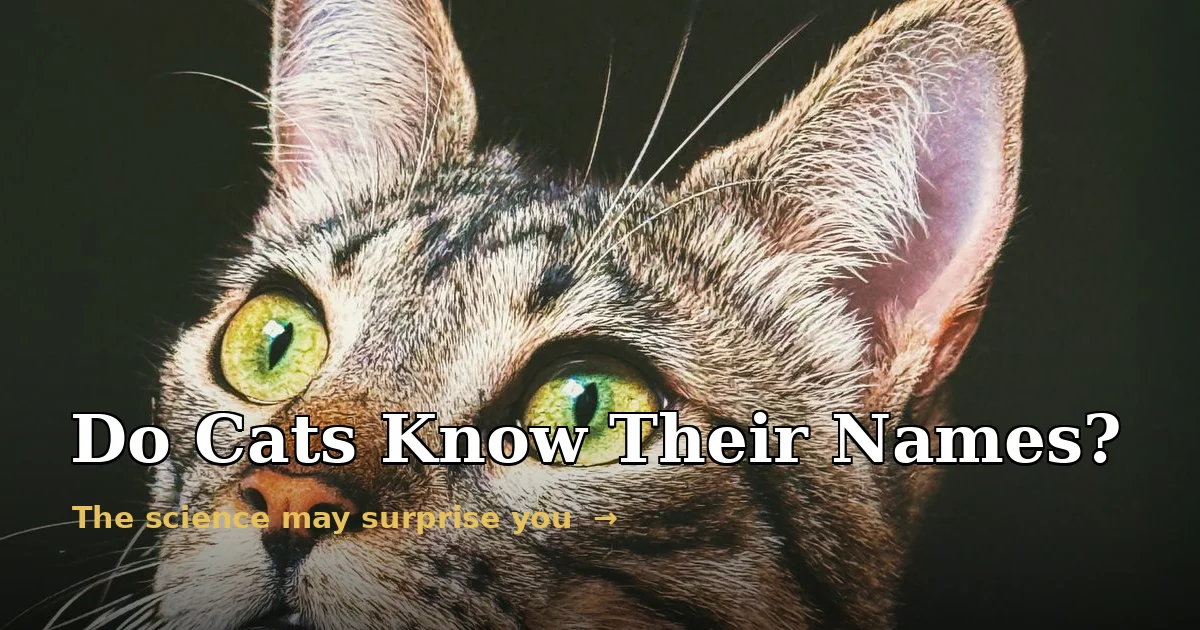
Do Cats Really Know Their Names?
The short answer: yes. Most cats can pick their own name out from a lineup of similar-sounding words — even when a stranger says it. That comes from a real experiment on 77 cats, published in 2019. But here is the part that will sting a little: knowing its name and answering to it are two very different things. Your cat probably knows exactly who you are calling. It is just choosing not to come.
Every cat owner has lived this moment. You call your cat. Nothing. You call again, a little louder. One ear rotates toward you — a full ninety degrees, like a tiny satellite dish — and then the cat goes back to staring at the wall. Dogs would have sprinted across the room by now. So what is going on? Is your cat deaf to its name, or just rude?
Scientists actually tested this properly, and the answer is more interesting than either option. Let me walk you through what they did, what they found, and — the useful part — how you can run a version of the test on your own cat this weekend.
How scientists tested whether cats know their names
The best-known study comes from Japan. Atsuko Saito, a behavioral scientist at Sophia University in Tokyo, spent three years running experiments on 77 pet cats, and published the results in the journal Scientific Reports in 2019. Before this, almost nobody had seriously studied whether cats understand human words at all — dogs had been studied to death, cats barely at all.
The test itself was clever in its simplicity. It used a method called habituation-dishabituation, which is a fancy way of saying: bore the cat first, then surprise it.
Here is how it worked. Researchers played a recording of the owner saying four ordinary words, one after another — words chosen to sound like the cat’s name. A cat named Kari, for example, would hear words like hifu and shuto. By the fourth word, most cats had stopped reacting entirely. They had habituated. Boring sounds, no point paying attention.
Then came the fifth word: the cat’s actual name.
If the cat perked up at that point — moved its ears, turned its head, swished its tail, meowed — while having ignored the four decoy words, that was evidence it could tell its name apart from other words. It is a clean design, because the only thing different about the fifth word is the sound pattern itself.

What the study actually found
The results were clear: cats from ordinary homes could reliably tell their own names apart from similar-sounding words — and they could do it even when the voice on the recording belonged to a stranger, not their owner. The response was weaker with a stranger’s voice, but it was still there.
The researchers also ran a harder version of the test. In homes with several cats, they played the names of the other cats in the house as the decoys. Home cats still picked out their own name. Cats living in a cat café, surrounded by dozens of other cats and many different humans, mostly could not — they reacted to housemates’ names about as much as their own. The researchers’ read on this makes sense: a home cat hears one name, said the same way, by the same few people, every single day. A café cat hears everything from everyone. Consistency is what makes a name learnable.
A follow-up study from Kyoto University in 2022 added another twist: cats living with other cats could also recognize the names of their feline housemates — especially in homes where the cats spent a lot of time together. Your cats probably know each other’s names better than you think.
The important fine print: recognition is not understanding
Before we hand cats a diploma, Saito herself pumped the brakes. In interviews about the study, she said the cats had probably learned to associate the sound of their name with rewards or punishments — food appearing, petting starting, or being scooped up for a vet visit. What there is no evidence for is that cats understand a name the way we do: as a label attached to the self.
“There is no evidence that cats have the ability to recognize themselves, like us,” she explained. “So the recognition of their name is different from ours.”
Think of it this way. Your cat does not think, “Ah, ‘Miso’ — that is me, the individual.” It thinks something closer to: “That particular sound pattern predicts that something is about to happen to me.” It is still impressive — the cat is slicing fine phonetic differences out of human speech — but it is pattern recognition, not identity.
And one more honest note from the researchers: a cat that did not react may still have recognized its name. Non-response is not proof of ignorance. Which brings us to the real question every owner is asking.
Why your cat still ignores you
If cats know their names, why does calling them feel like shouting into a void? A few honest reasons:
1. The name predicts nothing worth moving for. If “Miso!” usually means “come here so I can put you in the carrier,” Miso has learned exactly what that sound means — and the correct response is to stay under the bed. Names get their power from what follows them.
2. Cats were never bred for obedience. Dogs spent thousands of years being selected for responsiveness to human cues. Cats domesticated themselves, mostly, by hanging around grain stores and being useful. Nobody ever bred a cat for its recall. The 2019 researchers noted that cats’ responses were far less enthusiastic than a dog’s would be — ear flicks and head turns, not joyful sprinting.
3. Your cat may be responding and you are missing it. In the study, “responses” included things as subtle as a slight ear movement or a brief head turn. That satellite-dish ear swivel you see? That is the response. Your cat heard you. It logged the information. It simply filed it under “noted, declining to act.”
How to test it at home (the 5-word game)
You can run a simplified version of Saito’s experiment on your own cat. It takes five minutes and it is genuinely fun.
You will need: your cat in a calm, neutral mood (not mealtime, not mid-nap-fury), and a helper to say the words so your body language does not give anything away.
- Pick four decoy words that sound roughly like your cat’s name — same number of syllables, similar vowel sounds. For “Luna,” you might use Luda, Luka, Luma, Lupa.
- Have your helper say each decoy word in a neutral tone, about 15 seconds apart, while you watch the cat. Most cats will stop reacting by word three or four. That is habituation — exactly what you want.
- Then say the real name, in the same neutral tone.
- Watch closely. Ears rotating, head turning, eyes widening, tail movement, or vocalizing within a few seconds all count as recognition.
Try it a few times on different days before drawing conclusions — one sleepy afternoon proves nothing. And be honest with yourself about subtle responses. If the ear moved, the cat heard its name. Science says so.

How to actually teach a cat its name
If your test suggests the name is not landing, the fix is straightforward — it is the same mechanism the researchers described: pair the sound with good things, consistently.
Say the name, then immediately deliver something good. A treat, a chin scratch, a favorite toy — within two seconds of saying the name. Repeat in short sessions, five to ten times, a couple of times a day. You are building the association the study talks about: this sound predicts nice things.
Use the name the same way every time. Remember the café cats: inconsistency is the enemy. One person saying “Miso,” another saying “Miso-bean,” a third saying “hey you” — that is three different sound patterns to the cat. Pick one name and get the whole household on board.
Do not poison the name. If the name only ever precedes baths, nail trims, and vet carriers, the cat will learn it perfectly — and run. Use a different sound (or just go fetch the cat silently) for unpleasant duties.
Keep it short and distinct. Two syllables with a clear vowel ending — the classic Luna, Milo, Nala pattern — are easier for a cat to slice out of background speech than a four-syllable mouthful. If you are still choosing, our cat names guide is built around exactly this kind of thinking.
Choosing a name your cat can actually learn
The science points to a few practical rules that are worth knowing before you commit to calling something across the house for the next fifteen years:
- Two syllables beat four. Short names are easier to distinguish from the stream of human chatter. This is why Milo works and Bartholomew becomes “Bart” within a week.
- End on a vowel sound. Names ending in “ee” or “a” sounds — Lucy, Nala, Miso — carry further and cut through background noise better.
- Avoid sound-alikes in the house. If you have two cats, do not name them Luna and Luda. The study showed cats struggle most when names overlap — give each cat its own distinct sound territory. Our sister cat names guide pairs names that sound different on purpose.
- Skip names that sound like commands. “Kit” and “sit” live in the same neighborhood to a cat’s ears. If the name collides with a word you shout often, pick another.
- Test-drive it out loud. Say the name the way you would yell it across a garden at 7am. If it feels awkward or gets tangled with another word, it will only get worse with time.
And if you want names with a little more drama, the magical cat names and royal cat names collections both stick to the short-and-clear pattern — grand without being unpronounceable.
Frequently asked questions
Do cats know their names or just the tone of your voice?
Both play a role, but the 2019 Saito study controlled for tone: the decoy words and the real name were all spoken in the same neutral tone, and cats still reacted specifically to their names. They are hearing the actual sound pattern, not just reading your mood.
At what age do kittens learn their names?
There is no exact studied age, but the mechanism is simple association — name paired with good things, repeated consistently. Most kittens start responding within a few weeks of consistent use. The study tested cats from six months to 17 years old, and age did not seem to be the deciding factor; consistency was.
Why does my cat respond to any name I say?
That usually means the cat has learned that human speech directed at it predicts attention, rather than learning one specific sound pattern. It is also common in multi-cat homes where names get used loosely. Tighten up: one name, said the same way, followed by something good.
Do cats know the names of the other pets in the house?
Evidence says yes — a 2022 Kyoto University study found cats living together could recognize their housemate cats’ names, especially in homes where the cats were closely bonded. So when you scold one cat by name, the other one probably knows exactly who is in trouble.
Is it okay to rename an adopted adult cat?
Absolutely. Since cats learn names as sound-reward associations rather than identity labels, an adult cat can learn a new name the same way a kitten does — with consistent pairing over a few weeks. Shelters rename cats routinely. If you are considering it, names with a fresh, distinct sound work best; browse uncommon cat names or winter cat names for ideas that will not collide with the old one.
Do cats recognize their names when a stranger says them?
Mostly, yes. In the Saito study, cats still distinguished their own names when the recording was made by an unfamiliar researcher rather than the owner — the response was just weaker. So your cat sitter is not imagining it when the cat reacts.
The bottom line
Your cat almost certainly knows its name. Science tested 77 cats and found they can slice their own name out of a lineup of similar-sounding words, remember which sounds belong to them across voices, and even track the names of the other cats in the house. What they will not do is pretend to be dogs about it.
So the next time you call and get nothing but a rotating ear, take it as what it is: confirmation. The ear moved. The message was received. The cat has simply reviewed your request and declined — which, honestly, is the most cat thing imaginable.
And if you are still hunting for the right name in the first place, start with our complete cat names guide — built for real cats, tested against real science.

Hi, I’m Liam
I run Pet Names Lovers — every guide here starts from a question I’d want answered myself, researched properly, and written in plain English. I write, edit, and publish everything myself. More about me →