
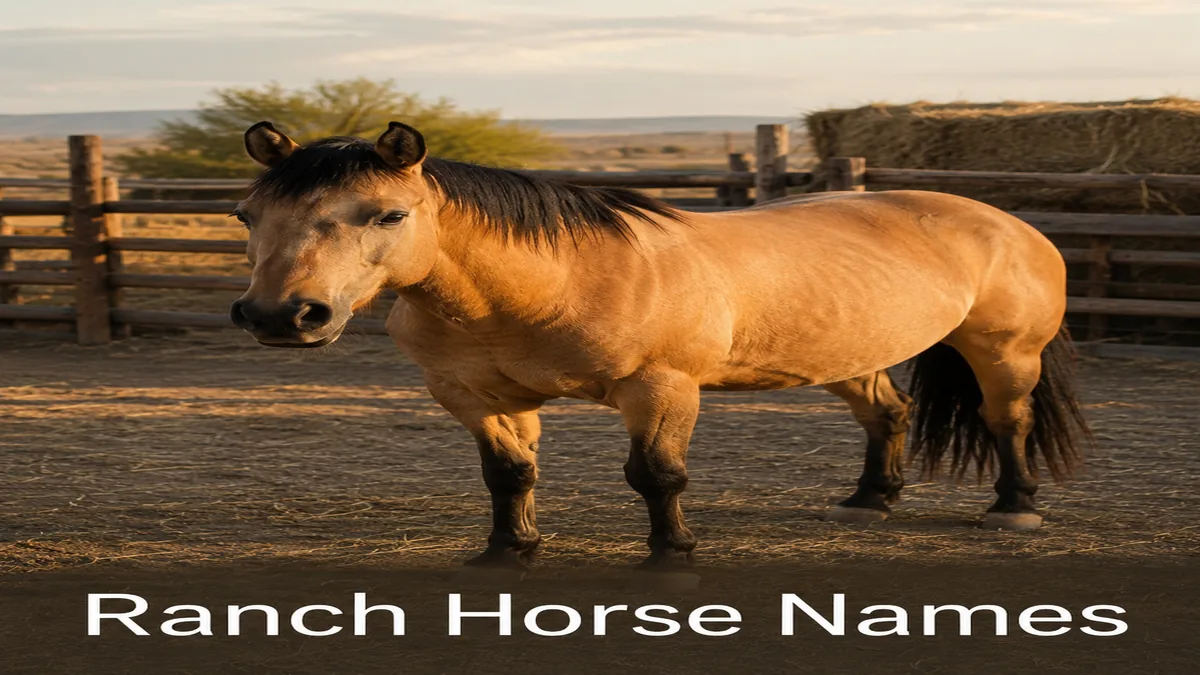
A ranch horse name should be short enough to holler across a pasture and sturdy enough to fit a horse that earns its keep think Scout, Rowdy, Dusty, Sage, or Cinch rather than anything with more than two syllables. Ranch horses get worked hard, called often, and usually named for what they do, how they look, or the ground they cover, not for a fairy-tale personality. Below are more than 350 of them, grouped by job, sex, coat, and cowboy tradition, each with a quick note on why it fits.
The colt came off the trailer at 4:30 in the morning, three days before branding, and my uncle looked at him for exactly four seconds before he said “Rowdy.” No debate, no list, no scrolling through baby-name sites at midnight. Rowdy had already kicked the trailer wall twice on the drive over, so the name picked itself.
That’s how it usually goes on a working ranch. You don’t sit down with a horse and get to know her personality over six months before you commit to a name. You’ve got a brand inspector coming, a vet form due, and thirty other animals that all need to be told apart at a shout. The name has to work that same afternoon.
What Makes a Good Ranch Horse Name?
A ranch horse name earns its keep the same way the horse does it has to be heard, remembered, and told apart from every other name in the barn.
Keep it to one or two syllables. “Tex,” “Duke,” and “Rio” carry across wind and distance. A four-syllable name gets swallowed by the time it reaches the far fence line, and you’ll end up shortening it anyway, so you might as well start there.
Pick a name that doesn’t sound like another horse’s, dog’s, or hand’s name on the place. Cutter and Cinch sound close enough in a shout to cause a wreck when you’re sorting pairs. If two names rhyme or share a first syllable, change one before it becomes a problem.
Let the horse’s job do some of the naming. A horse that’s steady enough to doctor sick calves from earns a different kind of name than a colt still learning to neck-rein. Working ranches have leaned on this logic for generations a good cutting horse becomes “Cutter,” a dependable rope horse becomes “Lariat” or “Dally,” because the name tells the next hand what the horse is for before they’ve ever swung a leg over.
Match the name to the horse you actually have, not the horse you’re hoping for. A green colt named “Outlaw” because you liked the sound of it tends to grow into the name. If you don’t want a horse that lives up to “Widowmaker,” don’t call him that on day one.
What Are Good Ranch Horse Names Based on Job or Skill?
Working ranches often name a horse for the job it does best, since that’s the trait the whole crew needs to remember. These fit any sex and work as a first pass before you even get to markings or bloodline.
- Cutter – for a horse with a natural feel for separating a calf from the herd
- Dally – after the wrap of rope around a saddle horn once a steer’s caught
- Lariat – a straightforward name for a dependable rope horse
- Wrangler – for the horse that gathers the remuda every morning
- Drover – an old term for someone who moves cattle over distance, fitting for a trail horse
- Heeler – for a horse that positions well behind a roped steer’s back legs
- Header – for a horse steady enough to work the front end of a team roping run
- Sorter – for a horse with quick feet and a sharp eye in the sorting pen
- Doc – short for a horse used to pony sick or injured stock
- Point – for the horse that rides at the front of a cattle drive
- Drag – for the patient horse that brings up the rear and eats the dust
- Flank – for a horse that holds the side of a moving herd
- Gather – for the horse you trust to bring everything home
- Remuda – Spanish-derived term for a string of ranch horses, bold as a standalone name
- Chore – a plain, almost funny name for the horse that does the daily rounds
- Pony – used as a verb on ranches, for a horse that leads a younger animal alongside
- Rider – simple and direct, for any all-around working horse
- Trailhand – for a horse that’s logged serious miles moving cattle
- Fence – for the horse that never puts a foot wrong along rough ground
- Gatekeeper – for a steady, reliable gate horse
- Sentry – for a watchful horse that notices trouble before you do
- Brand – a blunt, working name tied straight to branding season
- Tally – for a horse used during cattle counts and record days
- Circle – named for the morning circle ride to gather stock
- Camp – for a horse that’s spent seasons at line camp
- Rope – short and to the point, for a roping specialist
- Pen – for a calm horse that handles pen work without spooking
- Trot – for a horse with a smooth, ground-covering trot suited to long days
- Drift – for a horse that reads cattle movement and adjusts without being asked
- Steady – exactly what it says, for the horse the whole crew relies on
What Are Strong Male Ranch Horse Names?
Male ranch horses geldings especially tend to end up with short, blunt names that hold up to being shouted from a saddle in bad weather.
- Duke – classic, easy to call, never sounds out of place
- Tex – a nod to the region most ranch-naming traditions come from
- Rowdy – for a colt that announces himself before you’ve unloaded the trailer
- Cinch – named after the saddle strap, a name that feels tied to the work
- Dusty – for a horse that’s spent more time on dry ground than pavement
- Buck – a straightforward name, though better suited to a horse that doesn’t actually buck
- Colt – simple and honest, often given to a young horse that keeps the name for life
- Diesel – for a horse with power to spare on long days
- Gunner – for a bold, forward-moving horse
- Hank – a plain, dependable name with no pretense
- Jesse – short, easy on the ear, carries a frontier feel
- Reno – for a horse with a bit of Nevada grit in his attitude
- Sonny – for a bright, easygoing gelding
- Whiskey – for a horse with a warm, amber coat or a bold streak
- Marshal – for a horse that seems to keep order among the herd
- Copper – a classic color-adjacent name that also just sounds solid
- Ranger – for a horse that covers ground like it’s his job, because it is
- Boone – after the frontiersman, fitting for a horse that handles rough country
- Colter – another frontier-name pick, short enough to shout
- Denver – region-inspired, sturdy sounding
- Bandit – for a horse with a mischievous streak
- Grit – says exactly what it means
- Chance – for a horse you took on faith and it paid off
- Jasper – earthy and rugged, works for almost any coat
- Camino – Spanish for “path” or “road,” fitting for a well-traveled trail horse
- Bravo – Spanish for “brave” or “fierce,” short and punchy
- Chief – for a horse with an obvious sense of leadership in the herd
- Deacon – calm and steady sounding, for an unshakeable horse
- Fargo – frontier-sounding, easy to call
- Griff – short for Griffin, works well shouted
- Hondo – tough, western-sounding, one syllable does the job
- Jax – modern but still fits a working horse
- Kodiak – for a big-bodied, powerful gelding
- Lonestar – regional and bold, best shortened to “Star” day to day
- Marlow – steady and understated
- Nash – short, sharp, easy to holler
- Otis – old-fashioned and a little funny, for a horse with personality
- Pistol – for a quick, sharp-moving horse
- Quade – rugged sounding, one syllable
- Remy – short and quick to say
- Sarge – for a no-nonsense, dependable gelding
- Titan – for a horse built like he could pull a wagon alone
- Ulysses – shortened easily to “Uly,” a strong classic name
- Vandal – for a horse who gets into things he shouldn’t
- Wyatt – after Wyatt Earp, frontier grit built in
- Yuma – Arizona-inspired, tough and short
- Zane – modern, one syllable, easy to shout
- Ace – for a top hand’s top horse
- Blaze – for a horse with a bold white facial marking
- Chester – old-fashioned, solid, dependable-sounding
- Dozer – for a horse that pushes through rough ground without hesitation
- Ember – for a horse with a warm, reddish coat
- Flint – hard, sharp, a name that suggests he won’t spook easy
- Gus – short, friendly, still tough enough for ranch work
- Hondo Jack – a two-word combo some outfits use for extra character
- Ivan – blunt and strong sounding
- Jack – timeless, one syllable, always works
- Kirby – unexpected but easy to call
- Lobo – Spanish for “wolf,” fitting for an independent-minded horse
- Miles – for a horse that’s put in the distance
- Ned – old-fashioned, plain, and easy to shout
- Odin – for a horse with real presence in the herd
- Pete – classic ranch-hand name, works just as well for a horse
- Quincy – a little unusual, still short enough to call
- Rio – Spanish for “river,” smooth and easy to say
- Sam – simple, dependable, no wasted syllables
- Trace – named for the traces on a harness, fitting for a work horse
- Utah – regional, short, strong
- Vic – blunt and confident
- Walker – for a horse with an easy, ground-covering gait
- Ford – for a horse that’s reliable in any weather, machine-tough
- Gauge – modern working-ranch name, short and sharp
- Hoss – old cowboy slang for a big, strong horse
- Ike – short for Isaac, plain and steady
- Jett – for a fast-moving, dark-coated gelding
- Kane – blunt, strong, easy to call
- Lucky – for a horse with a good story behind how he ended up on the place
- Mack – short, tough, no-frills
- Bo – one syllable, about as easy to shout as a name gets
- Clay – earthy and plain, fits almost any working gelding
- Dash – for a horse with real speed off the mark
- Eli – short, old-fashioned, easy to call
- Finn – modern but still quick to shout across a corral
What Are Good Female Ranch Horse Names?
Mares on a working ranch tend to carry names that are just as short as the geldings’, though a few lean softer without losing their edge.
- Sage – for the sagebrush that covers most working rangeland
- Dakota – regional, easy to shorten to “Kota”
- Bonnie – classic, friendly, still practical
- Ruby – for a mare with a reddish or chestnut coat
- Copper Belle – a two-word name some outfits favor for extra color detail
- Cheyenne – regional and strong sounding
- Sierra – for a mare with a steady, mountain-worthy stride
- Willow – for a lean, flexible-moving mare
- Prairie – open and direct, fits a mare bred for wide country
- Belle – short, classic, easy to call
- Annie – after Annie Oakley, a nod to frontier grit
- Mesa – for a mare as steady as flat, high ground
- Reata – Spanish-derived word for a rawhide lariat, fitting for a rope-broke mare
- Vaquera – the feminine form of “vaquero,” or cowherd, for a mare with real cattle sense
- Estrella – Spanish for “star,” shortened easily to “Star” on a busy day
- Paloma – Spanish for “dove,” soft-sounding but still short
- Reina – Spanish for “queen,” for a mare who runs the herd
- Chispa – Spanish for “spark,” for a quick, energetic mare
- Luna – Spanish for “moon,” common and easy to shout
- Gitana – Spanish for “gypsy,” for a free-moving, independent mare
- Amber – warm and simple, works for a golden or chestnut coat
- Sadie – old-fashioned, easy to call, no wasted syllables
- Georgia – regional, sturdy sounding
- Charlie – unisex but common for mares on working outfits
- Piper – short, sharp, easy in a shout
- Rosie – classic and friendly without being fussy
- Scout – unisex, for a mare with a sharp instinct for the trail
- Story – a quieter pick, still one clean syllable when shortened to “Stor”
- Trixie – old cowhand favorite, plain and quick to say
- Winnie – short for Winifred, old-fashioned and dependable-sounding
- Zia – short, sun-symbol name borrowed from the Southwest
- Aspen – for a mare with a light, quick-moving stride
- Bexley – modern but still short enough to work
- Clover – for a mare that seems to bring good luck to the outfit
- Dixie – regional, classic ranch-mare name
- Etta – old-fashioned, one clean syllable when called
- Frankie – unisex, blunt, easy to shout
- Goldie – for a mare with a palomino or golden coat
- Hazel – earthy, easy to say, not fussy
- Ivy – short and simple, works well for a lean-built mare
- Josie – old-fashioned, dependable sounding
- Kit – short for Christopher or just standalone, quick to call
- Lacy – soft-sounding but still short
- Maddie – common, easy, practical
- Nell – old cowhand-mare name, blunt and short
- Opal – for a mare with a shimmering or unusual coat pattern
- Poppy – bright and short, easy to call in a hurry
- Queenie – for the mare who’s clearly in charge of the herd
- Roxy – blunt, easy to shout
- Sassy – for a mare with an obvious independent streak
- Trudy – old-fashioned, plain, dependable
- Uma – short and clean sounding
- Vera – old-fashioned, one clean syllable when called “Ver”
- Wren – short, sharp, fits a quick-moving mare
- Xena – for a mare with an obvious commanding presence
- Yara – short, easy to shout, uncommon enough to stand out
- Zelda – blunt and quick, easy to call
- Bess – old ranch-mare classic, plain and dependable
- Carly – common, easy, practical for daily use
- Dot – for a mare with a spotted coat or a single distinct marking
- Ellie – friendly, short, works well shouted
- Fable – for a mare with a story worth telling
- Ginger – for a reddish coat and a bit of spirit
- Honey – soft-sounding but still just two syllables
- Indie – modern, short, easy to call
- Journey – for a mare who’s logged real miles on the trail
- Kacey – unisex, common on working outfits
- Lark – short, sharp, easy in a shout
- Marigold – shortened easily to “Mari” for daily use
- Nova – short, modern, still fits a working mare
- Olive – earthy, plain, easy to call
- Pepper – for a mare with a speckled or dark coat
- Quinn – blunt, one syllable, works well
- Rain – simple, weather-tied, easy to call
- Star – classic and blunt, fits almost any mare
- Trigger Belle – a nod to the classic Trigger name with a feminine twist
- Val – short for Valentina or standalone, clean and quick
- Wyoming – regional, shortened to “Wy” on a busy day
- Birdie – short, cheerful, easy to shout
- Cassie – common, easy, no wasted syllables
- Della – old-fashioned, plain, dependable-sounding
- Effie – short and old-fashioned, calls well across a pen
- Faye – one syllable, blunt and clean
What Are Good Ranch Horse Names Based on Coat and Markings?
A coat color or marking is often the fastest way to tell horses apart at a distance, which is exactly why so many working names come from what the horse looks like.
- Blaze – for a bold white stripe down the face
- Socks – for four matching white lower legs
- Star – for a small white marking on the forehead
- Smoky – for a grey or blue roan coat
- Rusty – for a reddish or chestnut coat
- Midnight – for a solid black coat
- Speck – for a lightly speckled or roan pattern
- Patch – for a horse with one large distinct marking
- Frosty – for a horse with a grey, frost-tipped coat
- Amber – for a warm, golden-brown coat
- Charcoal – for a deep, dark grey coat
- Cocoa – for a rich brown coat
- Sandy – for a light tan or dun coat
- Snip – for a small white mark on the muzzle
- Bay – used plainly as a name for a classic reddish-brown, black-pointed coat
- Roany – a casual nickname turned name, for any roan-coated horse
- Cream – for a pale, near-white coat
- Onyx – for a deep black, glossy coat
- Marble – for a mottled or dappled coat pattern
- Storm Cloud – for a dark grey coat with lighter dappling
- Freckles – for a horse with lots of small markings
- Copperhead – for a deep reddish coat, blunt and memorable
- Champagne – for a pale golden, shimmering coat
- Pinto – used directly as a name for a two-toned coat
- Buckskin – used directly for a tan body with black points
- Dapple – for a coat with distinct light-and-dark circular markings
- Ash – for a light grey coat
- Coal – for a deep black coat, one blunt syllable
- Sable – for a dark brown, almost black coat
- Golden – for a bright palomino coat
- Steel – for a hard grey-blue coat
- Cinder – for a dark, ash-toned grey
- Flax – for a chestnut coat with a lighter mane and tail
- Ivory – for a near-white coat
- Ebony – for a deep, solid black
- Sorrel – used directly as a name for a copper-red coat
- Slate – for a muted blue-grey coat
- Ghost – for a pale, near-white or grey coat
- Domino – for a horse with strong black-and-white patterning
- Rust – blunt and short, for a reddish coat
- Chalk – for a chalky white or cream coat
What Are Classic Cowboy and Old West Ranch Horse Names?
These lean on frontier history and cowboy tradition rather than a horse’s job or looks, and they still hold up as short, callable names.
- Trigger – a nod to the most famous ranch horse name in western film history
- Silver – another classic western-film reference, works for any light-coated horse
- Champ – short for champion, an old rodeo-arena favorite
- Buckshot – for a horse with a bit of spark and speed
- Cactus – rugged and short, borrowed straight from the landscape
- Deadwood – regional and historic, works well shortened to “Dead-eye” informally
- Marshal Dan – a two-word frontier name with real character
- Outlaw – for a horse with an independent streak
- Maverick – for an unbranded, free-thinking horse
- Sundance – after the outlaw’s nickname, for a bold, quick horse
- Cheyenne Kid – regional and old-west in feel
- Doc Holliday – shortened easily to just “Doc” for daily use
- Calamity – after Calamity Jane, for a mare with real grit
- Annie Oakley – shortened to “Annie” for a sharp, confident mare
- Sheriff – blunt and commanding, fits a lead horse in the herd
- Deputy – a step below Sheriff, still a strong, working-sounding name
- Rustler – bold, a little mischievous
- Bronco – old rodeo-arena term, works well as a standalone name
- Saddle Tramp – a classic cowboy phrase, best shortened to “Tramp”
- Vaquero – Spanish for cowherd, the root word behind “buckaroo”
- Rio Grande – regional, best shortened to “Rio” for daily calling
- Tombstone – blunt and historic
- Frontier – direct and easy to shorten to “Front” if needed
- Homestead – ties straight to ranch history, shortened to “Home”
- Prospector – old west, shortened to “Prospect” or “Pros”
- Gunslinger – shortened easily to “Gun” for daily use
- Bandolero – Spanish for “bandit,” bold and rhythmic
- Rancher – blunt and literal
- Cowpoke – old cowhand slang, informal but memorable
- Wildcat – for a horse with a sharp, unpredictable streak
- Buckaroo – an anglicized version of vaquero, tied directly to ranch history
- Drifter – for a horse that seems to wander the pasture on his own schedule
- Nugget – gold-rush inspired, short and warm
- Canyon – rugged and regional
- Mesquite – named for the hardy rangeland tree
- Territory – shortened to “Terry” for daily use
- Frontiersman – shortened to “Front” or “Frontie”
- Stagecoach – shortened to “Stage” for daily calling
- Roundup – ties directly to ranch season, shortened to “Round”
- Homestead Rose – a two-word combo for a mare with old-west character
What Are Good Spanish and Vaquero-Inspired Ranch Horse Names?
Western ranch culture in the United States grew directly out of vaquero horsemanship, so Spanish-language names have deep, legitimate roots in ranch tradition not just borrowed flavor.
- Rayo – Spanish for “ray” or “bolt of lightning”
- Trueno – Spanish for “thunder”
- Relámpago – Spanish for “lightning,” a mouthful best shortened to “Relám”
- Fuego – Spanish for “fire”
- Sol – Spanish for “sun,” short and easy to call
- Cielo – Spanish for “sky”
- Dorado – Spanish for “golden,” fitting for a palomino
- Plata – Spanish for “silver”
- Valiente – Spanish for “brave”
- Fiera – Spanish for “fierce”
- Diablo – Spanish for “devil,” for a horse with real spirit
- Amigo – Spanish for “friend”
- Compadre – Spanish for “close companion”
- Chaparro – Spanish slang for a short or compact horse
- Bonita – Spanish for “pretty,” for a mare with a striking look
- Capitán – Spanish for “captain,” for a lead gelding
- Coyote – used directly as a name for a horse with an independent streak
- Tequila – bold and short, a common ranch-name pick
- Mariachi – for a horse with a lively, spirited step
- Rancho – Spanish for “ranch,” used directly and plainly
- Bravo – Spanish for “wild” or “brave,” short enough to shout
- Cazador – Spanish for “hunter,” for a sharp-eyed horse
- Guerrero – Spanish for “warrior,” best shortened to “Guer”
- Alma – Spanish for “soul,” short and easy to call
- Cielo Azul – Spanish for “blue sky,” shortened to “Azul” day to day
- Corazón – Spanish for “heart,” shortened to “Cora” for daily use
- Estrellita – Spanish for “little star,” shortened to “Star” or “Strell”
- Montaña – Spanish for “mountain,” for a big, sturdy horse
- Pampas – named for the open grassland plains of South America
- Toro – Spanish for “bull,” bold and blunt
- Viento – Spanish for “wind,” for a fast-moving horse
What Are Good Ranch Horse Names Inspired by the Land?
Rangeland itself gives up plenty of short, sturdy names, and they tend to age well since the landscape isn’t going anywhere.
- Canyon – rugged, short, easy to shout
- Mesa – for a horse as steady as flat-topped high ground
- Prairie – open and direct
- Timber – earthy and dependable
- Juniper – for a hardy, drought-tolerant kind of horse
- Cedar – short, sturdy, easy to call
- Aspen – light and quick-sounding
- Sagebrush – shortened to “Sage” for everyday use
- Bluff – blunt and short, named after a rangeland landform
- Ridge – short and strong
- Mesquite – tied to hardy rangeland brush
- Cottonwood – shortened to “Wood” or “Cotton” for daily calling
- Sundown – for a horse best worked in the cool of evening
- Sunrise – for an early riser, first one out to pasture
- Tumbleweed – shortened to “Weed” or “Tumble” for daily use
- Windmill – ties straight to ranch infrastructure, shortened to “Mill”
- Coyote Creek – regional, shortened to “Creek” or “Coyote”
- Dust – blunt and short, a plain working name
- Gravel – tough-sounding, easy to call
- Grit – direct, no wasted syllables
- Horizon – shortened to “Ryzon” or just “Rizzy” for daily use
- Meadow – soft-sounding but still short
- Ranchland – shortened to “Ranch” for a plain, honest name
- Range – blunt and one syllable
- River – simple, classic, easy to call
- Rock – as plain and sturdy as it sounds
- Boulder – tough and regional
- Stormfront – shortened to “Storm” for daily calling
- Sunbelt – regional and warm-sounding
- Trailhead – shortened to “Trail” for everyday use
- Valley – soft but still short and clear
- Wildrye – named after a native rangeland grass
- Basin – short and geographic
- Butte – one clean syllable, named after the flat-topped hill formation
- Chaparral – shortened to “Chap” for daily use
- Foothill – shortened to “Foot” or “Hilly” informally
- Highland – regional and sturdy
- Longhorn – ties directly to ranch cattle history
- Plateau – shortened to “Plato” or “Plat” for daily calling
- Wrangle – blunt and tied straight to the daily work
- Yonder – old ranch-talk for distance, unusual but memorable as a name
- Arroyo – named for a dry creek bed, common across ranch country
- Brush – blunt and short, tied to rangeland scrub
- Dune – short, simple, fits a sandy-country horse
- Flint Ridge – a two-word combo, shortened to “Flint” for daily use
- Homeground – shortened to “Home” for a horse that never strays far
How Do You Choose the Right Name From This List?
Start with the horse in front of you, not the list. Watch how the horse moves for the first few days — a colt that hits the ground running before you’ve even got a halter on suits Rowdy or Gunner better than something soft like Willow.
Say the name out loud, across a real distance, before you commit. Stand at one end of the arena and have someone at the other end call it. If it gets lost in the wind or sounds like another horse’s name on the place, pick something else.
Think about who else will be using the name. If a hired hand, a kid, or a vet tech has to say it under pressure, a name like “Sir Reginald of the Northern Pastures” isn’t going to survive first contact with a busy morning. It’ll get shortened whether you plan for it or not, so plan for it.
What Mistakes Do People Make When Naming a Ranch Horse?
The most common mistake is picking a name before the horse has shown you anything about itself. A name chosen off a list in the truck on the way home sometimes fits fine, but it’s worth waiting a day or two if you can, especially with a horse you’ll have for fifteen or twenty years.
The second mistake is choosing something long and elegant, then fighting it for the horse’s whole life. If “Guinevere” gets shortened to “Gwen” by week two anyway, you might as well have started with Gwen.
The third mistake is naming a horse something you wouldn’t want announced over a loudspeaker at a branding, a vet clinic, or a 4-H show. It seems funny in the barn. It’s a lot less funny in front of a crowd.
The fourth mistake, and probably the most avoidable, is duplicating a name already in use on the place human or animal. Calling “Duke” and having both a ranch dog and a gelding come running wastes time nobody has during a real workday.
Closing
Back on that trailer at 4:30 in the morning, Rowdy never got a second name option. He kicked twice, my uncle laughed, and that was that thirteen years and a lot of branding seasons later, it still fits him exactly as well as it did that first morning. Most good ranch horse names work the same way: they’re not agonized over, they’re just noticed. Whatever name you land on from this list, give the horse a few days to prove it right before you write it down anywhere permanent.
If your new horse turns out to be more show ring than ranch yard, our guides to quarter horse names and western horse names cover some of the same territory from a different angle. And if you’re still deciding between a colt or a filly, our male horse names and female horse names lists go a lot deeper than what fits here.
FAQ
Short, one- or two-syllable names that carry across distance work best names like Scout, Duke, Sage, or Rio. Many working ranches also name a horse for its job (Cutter, Lariat, Wrangler) or its coat (Blaze, Rusty, Smoky), since those names double as quick identifiers in a herd.
Mares on working ranches usually get names just as short as the geldings’ Sage, Dakota, Bonnie, Ruby, and Reina are common picks. Spanish-derived names like Estrella or Paloma also have deep roots in vaquero and ranch tradition.
Duke, Tex, Rowdy, Cinch, and Hank are classic choices for geldings, since they’re blunt, easy to shout, and don’t get lost in wind or distance. Job-based names like Roper or Sorter also work well for a gelding that’s earned a specific role.
Names tied to frontier history and vaquero tradition Trigger, Vaquero, Rustler, Bronco, Sundance remain popular because they carry real western horsemanship history rather than just sounding rugged.
It’s a longstanding, practical naming approach. A horse that excels at cutting cattle becomes “Cutter,” a dependable rope horse becomes “Lariat,” and the name helps everyone on the crew remember what the horse is good for.
2 thoughts on “350+ Ranch Horse Names: Working Horse Ideas for Male and Female Horses”