
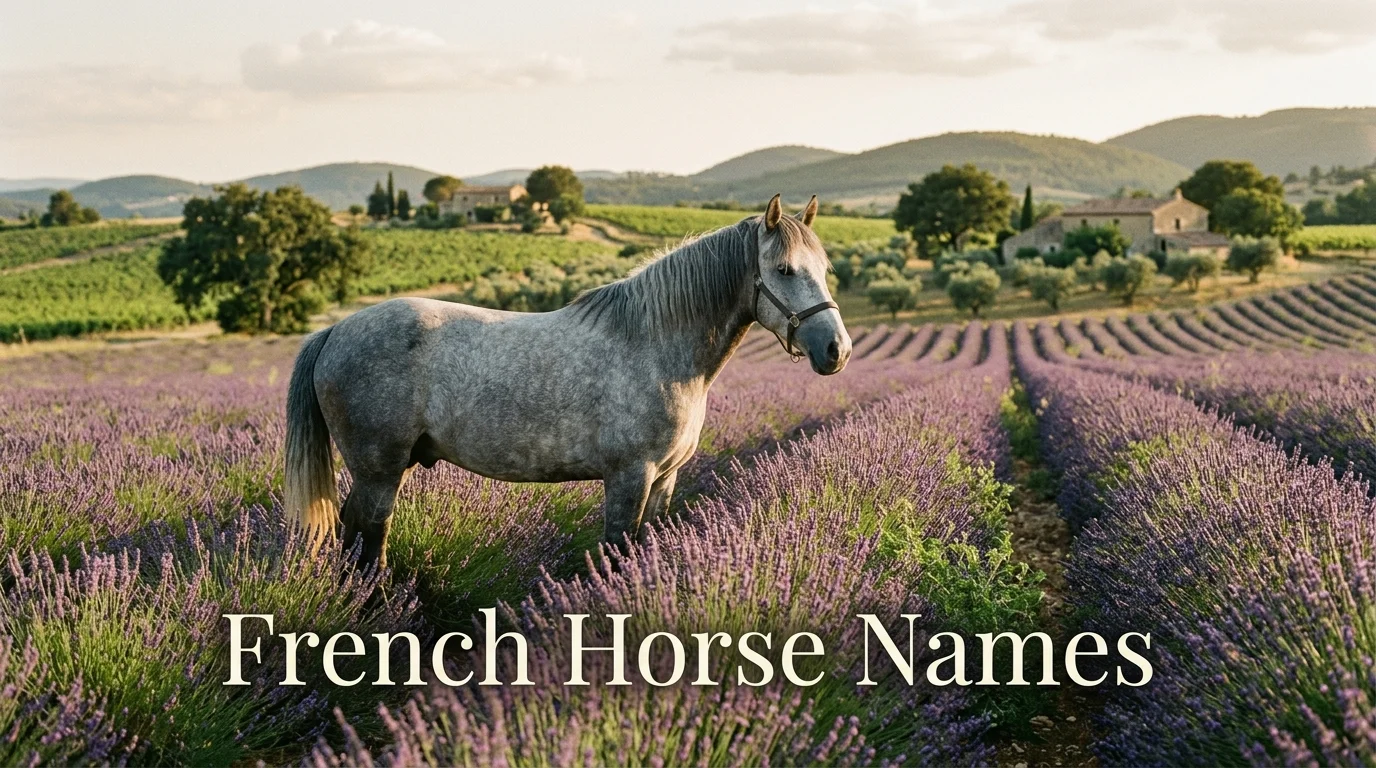
French horse vocabulary splits by more than just gender. “Cheval” is the general word for horse, “jument” is specifically a mare, “étalon” is a stallion, and “hongre” is a gelding, which gives French horse names a lot more precision to work with than a simple male-female split.
A Quick Grammar Note Before the List
Most French words carry gender the way “blond” and “blonde” do in English. A masculine color word like “noir” (black) becomes “noire” for a mare, and the same shift applies across most of the names below.
That’s genuinely useful when picking a name, not just trivia. It means a single French word can often give you both a male and a female version for free.
Naming Conventions at a Glance
| Term | Meaning | Use |
|---|---|---|
| Cheval | Horse (general term) | Any horse, gender-neutral |
| Jument | Mare | Female horses specifically |
| Étalon | Stallion | Intact male horses |
| Hongre | Gelding | Castrated male horses |
Male French Horse Names
- Adrien – from the Roman place name Hadria
- Alexandre – “defender of the people”
- Antoine – linked to the Latin for “priceless”
- Bastien – short form tied to “revered”
- Benoît – “blessed”
- Blaise – linked to an old word for “lisp”
- César – “emperor”
- Christophe – “bearer of Christ”
- Clément – “merciful, gentle”
- Cyril – “lordly, masterful”
- Denis – tied to the god Dionysus
- Didier – “desired”
- Dominique – “belonging to the Lord”
- Édouard – “wealthy guardian”
- Émile – “eager, rival”
- Emmanuel – “God is with us”
- Étienne – “crown, garland”
- Fabrice – “craftsman”
- Félix – “happy, fortunate”
- Frédéric – “peaceful ruler”
- Gabin – tied to the ancient town of Gabium
- Gaspard – “treasurer”
- Gaston – “guest, stranger”
- Henri – “ruler of the home”
- Hervé – “battle-worthy”
- Hugo – “mind, intellect”
- Julien – “youthful”
- Kévin – “handsome, gentle”
- Laurent – “crowned with laurel”
- Léo – “lion”
- Marcel – “little warrior”
- Mathieu – “gift of God”
- Maxime – “greatest”
- Nicolas – “victory of the people”
- Noël – “Christmas”
- Olivier – “olive tree”
- Oscar – “divine spear”
- Pascal – tied to Easter
- Philippe – “lover of horses,” a fitting one for this list specifically
- Quentin – “fifth”
- Raphaël – “God has healed”
- René – “reborn”
- Romain – “Roman”
- Sébastien – “revered”
- Stéphane – “crown”
- Sylvain – “of the forest”
- Théodore – “gift of God”
- Thibault – “bold people”
- Thierry – “ruler of the people”
- Valentin – “strong, healthy”
- Victor – “conqueror”
- Xavier – “new house”
- Yves – “yew wood”
- Zacharie – “the Lord remembers”
- Armand – tied to the Germanic for “soldier”
- Baptiste – “baptizer”
- Damien – “to tame”
- Eloi – linked to a patron saint of horses and blacksmiths
- Fernand – “adventurous, bold journey”
- Guillaume – “resolute protector,” the French form of William
- Isidore – “gift of Isis”
- Jerome – “sacred name”
- Lucien – “light”
- Marius – Roman clan name, possibly tied to Mars
- Octave – “eighth”
- Pierre – “rock,” the French form of Peter
- Rémy – “oarsman,” also linked to a patron saint
- Serge – tied to an old Roman family name
- Vincent – “conquering”
- Arnaud – “eagle rule”
Female French Horse Names
- Adèle – “noble”
- Amour – “love”
- Anémone – for the anemone flower
- Béatrice – “bringer of joy”
- Biscotte – “little biscuit,” playful and sweet
- Céleste – “heavenly”
- Chérie – “dear, darling”
- Dahlia – for the dahlia flower
- Daphné – tied to a figure in Greek myth turned into a laurel tree
- Élise – a short form of Élisabeth
- Esmée – “esteemed, beloved”
- Étoile – “star”
- Fabiola – tied to an old Roman family name
- Fantaisie – “fantasy, whimsy”
- Fleur – “flower”
- Geneviève – patron saint of Paris
- Giselle – “pledge, hostage,” also a famous ballet
- Harmonie – “harmony”
- Hélène – the French form of Helen
- Inès – “pure,” the French form of Agnes
- Isabelle – “pledged to God”
- Jasmin – for the jasmine flower
- Jolie – “pretty”
- Juliette – “youthful”
- Karine – a French form of Katherine
- Kiki – playful nickname form
- Lorraine – tied to the historic French region
- Loulou – affectionate nickname form
- Lucie – “light”
- Lune – “moon”
- Mademoiselle – “miss,” a title used as a name
- Manon – a diminutive of Marie
- Marguerite – “daisy”
- Nadine – “hope”
- Nina – short, gentle nickname form
- Océane – “ocean”
- Ophélie – the French form of Ophelia
- Papillon – “butterfly”
- Pénélope – tied to the loyal wife in Homer’s Odyssey
- Perle – “pearl”
- Quenelle – named for the French dumpling dish, distinctive and quirky
- Quitterie – tied to an early French saint
- Reine – “queen”
- Rêve – “dream”
- Rosalie – “rose”
- Rose – “rose”
- Roxane – “little star,” originally a Persian name
- Sophie – “wisdom”
- Suzette – a diminutive of Suzanne
- Thérèse – “harvester”
- Tulipe – “tulip”
- Ursule – “little bear”
- Violette – “violet”
- Zélie – “zealous”
- Aimée – “beloved”
- Colette – “victorious people,” a diminutive of Nicole
- Delphine – tied to the city of Delphi
- Eugénie – “well-born”
- Fifine – playful nickname form
- Gabrielle – “God is my strength”
- Huguette – “of the mind, intellect”
- Irène – “peace”
- Josette – a diminutive of Joséphine
- Léonie – “lion-hearted”
- Margot – a diminutive of Marguerite
- Noémie – “pleasantness”
- Odette – “wealth, fortune”
- Pauline – “small”
- Simone – “one who listens”
- Yvette – “yew wood”
Cute French Horse Names
- Bijou – “jewel”
- Bisou – “kiss”
- Câlin – “cuddle”
- Chouchou – “favorite, darling”
- Doudou – a security blanket or comfort toy
- Mimi – playful nickname
- Nounours – “teddy bear”
- Petit – “small”
- Petite – “small,” feminine form
- Poussin – “chick,” also a term of endearment
- Trésor – “treasure”
- Bébé – “baby”
- Coquin – “rascal,” used affectionately
- Coquine – feminine form
- Mignon – “cute”
- Mignonne – feminine form
- Doux – “sweet, soft”
- Douce – feminine form
- Câline – “cuddly,” feminine form
- Frimousse – “cute little face”
- Zaza – playful nickname
- Fripon – “mischievous”
- Friponne – feminine form
- Cannelle – “cinnamon”
- Praline – for the sugared almond candy
- Nougat – for the chewy candy
- Caramel – “caramel”
- Berlingot – a striped French hard candy
- Sucrette – “little sweet one”
- Chaton – “kitten,” used affectionately
- Minou – “kitty,” an affectionate term
- Ange – “angel”
- Angelot – “little angel, cherub”
- Poupée – “doll”
- Gigi – playful nickname
- Fifi – playful nickname
- Coco – playful nickname
- Nini – playful nickname
- Pompon – “pom-pom,” light and playful
- Bichette – “little doe,” an affectionate term
Strong Male French Horse Names
- Fort – “strong”
- Puissant – “powerful”
- Robuste – “robust”
- Vaillant – “valiant”
- Brave – “brave”
- Hardi – “bold”
- Costaud – “sturdy, strapping”
- Solide – “solid”
- Vigoureux – “vigorous”
- Herculéen – “herculean”
- Titan – “titan”
- Colosse – “colossus”
- Fier – “proud”
- Féroce – “fierce”
- Guerrier – “warrior”
- Chevalier – “knight”
- Conquérant – “conqueror”
- Dominateur – “dominator”
- Invincible – “invincible”
- Indomptable – “untameable”
- Redoutable – “formidable”
- Tonnerre – “thunder”
- Foudre – “lightning bolt”
- Ouragan – “hurricane”
- Tempête – “storm”
- Roc – “rock”
- Granit – “granite”
- Acier – “steel”
- Fer – “iron”
- Bronze – “bronze”
- Marteau – “hammer”
- Gladiateur – “gladiator”
- Spartiate – “spartan”
- Centurion – “centurion”
- Général – “general”
- Capitaine – “captain”
- Commandant – “commander”
- Seigneur – “lord”
- Baron – “baron”
- Duc – “duke”
Unique French Horse Names
- Zéphyr – a gentle breeze
- Alizé – “trade wind”
- Mistral – the powerful wind of southern France
- Brouillard – “fog”
- Crépuscule – “twilight”
- Aube – “dawn”
- Ombre – “shadow”
- Nuage – “cloud”
- Orage – “thunderstorm”
- Averse – “rain shower”
- Rosée – “dew”
- Givre – “frost”
- Bourrasque – “gust, squall”
- Cyclone – “cyclone”
- Typhon – “typhoon”
- Volcan – “volcano”
- Comète – “comet”
- Nébuleuse – “nebula”
- Galaxie – “galaxy”
- Cosmos – “cosmos”
- Infini – “infinite”
- Mystère – “mystery”
- Énigme – “enigma”
- Sortilège – “spell, magic charm”
- Alchimie – “alchemy”
- Mirage – “mirage”
- Oasis – “oasis”
- Horizon – “horizon”
- Voyage – “journey”
- Vagabond – “wanderer”
- Nomade – “nomad”
- Errant – “wandering”
- Solitaire – “solitary”
- Fugitif – “fugitive”
- Insaisissable – “elusive”
- Éphémère – “ephemeral”
- Immortel – “immortal”
- Éternité – “eternity”
- Absolu – “absolute”
- Rêverie – “daydream”
Names Based on Color
- Rouge – “red”
- Noir – “black”
- Noire – “black,” feminine
- Blanc – “white”
- Blanche – “white,” feminine
- Gris – “grey”
- Grise – “grey,” feminine
- D’or – “golden”
- Doré – “golden,” adjective form
- Dorée – feminine form
- Argenté – “silvery”
- Argentée – feminine form
- Brun – “brown”
- Brune – “brown,” feminine
- Roux – “ginger, red-haired”
- Rousse – feminine form
- Café – “coffee,” for a coffee-brown coat
- Chocolat – “chocolate”
- Ivoire – “ivory”
- Ébène – “ebony”
- Cuivre – “copper”
- Marron – “chestnut brown”
- Beige – “beige”
- Châtain – “chestnut-brown,” typically for hair or coat
- Ambré – “amber-toned”
Names Based on Nature
- Chêne – “oak”
- Saule – “willow”
- Érable – “maple”
- Pin – “pine”
- Bouleau – “birch”
- If – “yew”
- Fougère – “fern”
- Lierre – “ivy”
- Mousse – “moss”
- Genêt – “broom,” the flowering shrub
- Bruyère – “heather”
- Lavande – “lavender”
- Romarin – “rosemary”
- Thym – “thyme”
- Basilic – “basil”
- Muguet – “lily of the valley”
- Iris – “iris”
- Pivoine – “peony”
- Coquelicot – “poppy”
- Jonquille – “daffodil”
- Freesia – “freesia”
- Orchidée – “orchid”
- Glycine – “wisteria”
- Chèvrefeuille – “honeysuckle”
- Aubépine – “hawthorn”
- Framboise – “raspberry”
- Myrtille – “blueberry”
- Groseille – “currant, gooseberry”
- Prune – “plum”
- Pêche – “peach”
- Abricot – “apricot”
- Figue – “fig”
- Noisette – “hazelnut”
- Amande – “almond”
- Châtaigne – “chestnut,” the nut
Names Based on Food and Drink
- Tarte – “tart, pie”
- Gateau – “cake”
- Beignet – “donut, fritter”
- Nougatine – a sugar-almond confection
- Confiture – “jam”
- Miel – “honey”
- Cidre – “cider”
- Cognac – the famous French brandy
- Armagnac – another classic French brandy
- Pastis – an anise-flavored liqueur
- Calvados – an apple brandy from Normandy
- Chartreuse – an herbal liqueur, also a shade of yellow-green
- Grenadine – pomegranate syrup
- Pamplemousse – “grapefruit”
- Cerise – “cherry”
- Poire – “pear”
- Pomme – “apple”
- Fraise – “strawberry”
- Citron – “lemon”
- Orange – “orange”
- Vanille – “vanilla”
- Girofle – “clove”
- Safran – “saffron”
- Anis – “anise”
- Camembert – the famous soft cheese
- Brie – the famous soft cheese
- Roquefort – the famous blue cheese
- Chèvre – “goat,” also goat cheese
- Cassoulet – a hearty southern French stew
- Bouillabaisse – the classic Marseille fish stew
- Niçoise – “from Nice,” best known from the salad
- Crêpe – the classic thin pancake
- Galette – a savory buckwheat crepe or flat cake
- Nectar – “nectar”
- Sirop – “syrup”
Elegant Show-Style Names
- Étoile du Soir – “Evening Star”
- Feu Follet – “Will-o’-the-Wisp”
- Vent d’Automne – “Autumn Wind”
- Ciel de Minuit – “Midnight Sky”
- Reflet de Lune – “Moon’s Reflection”
- Souffle de Vie – “Breath of Life”
- Danse des Rêves – “Dance of Dreams”
- Larme de Cristal – “Crystal Tear”
- Voile de Brume – “Veil of Mist”
- Chant du Cygne – “Swan Song”
- Rose des Sables – “Desert Rose,” also a real mineral formation
- Perle des Champs – “Pearl of the Fields”
- Ombre et Lumière – “Shadow and Light”
- Coeur de Velours – “Heart of Velvet”
- Souvenir Doré – “Golden Memory”
- Murmure du Vent – “Whisper of the Wind”
- Éclat de Rire – “Peal of Laughter”
- Grain de Folie – “Touch of Madness”
- Fleur de Givre – “Frost Flower”
- Baiser du Matin – “Morning Kiss”
- Sourire d’Ange – “Angel’s Smile”
- Danse Royale – “Royal Dance”
- Regard de Velours – “Velvet Gaze”
- Promesse d’Été – “Summer’s Promise”
- Chemin des Étoiles – “Path of Stars”
- Secret des Bois – “Secret of the Woods”
- Écho Lointain – “Distant Echo”
- Lueur d’Aube – “Glow of Dawn”
- Vague Bleue – “Blue Wave”
- Passion Ardente – “Ardent Passion”
- Noblesse Oblige – a real French phrase, “nobility obligates”
- Grâce Infinie – “Infinite Grace”
- Charme Discret – “Discreet Charm”
- Esprit Libre – “Free Spirit”
- Âme Sœur – “Soul Mate”
French Places and Culture-Inspired Names
France’s own horse culture gives you a shortcut most naming lists skip entirely.
- Provence – the sun-soaked southern region
- Normandie – Normandy, home to several French horse breeds
- Bretagne – Brittany, in France’s northwest
- Alsace – the eastern French region near Germany
- Bourgogne – Burgundy, famous for wine country
- Champagne – both a region and the drink
- Camargue – the wetland region famous for its native white horses
- Loire – the river and its castle-lined valley
- Rhône – the major river through southeastern France
- Seine – the river that runs through Paris
- Riviera – the glamorous southeastern coast
- Chantilly – famous for its château, lace, and horse racing
- Deauville – a classic French horse-racing and resort town
- Longchamp – Paris’ famous horse-racing course
- Fontainebleau – the historic royal forest and château
- Versailles – the iconic royal palace
- Montmartre – the artistic Paris hilltop district
- Marseille – France’s oldest major city
- Lyon – France’s culinary capital
- Avignon – the historic papal city
- Carcassonne – the walled medieval city
- Chamonix – the Alpine mountain town
- Annecy – the lakeside Alpine town
- Biarritz – the Basque coast resort town
- Nice – the Riviera’s largest city
- Cannes – famous for its film festival
- Dijon – famous for mustard
- Colmar – the fairy-tale Alsatian town
- Strasbourg – the city on the German border
- Toulouse – the “Pink City” of southern France
Short and Simple French Names
- Zaz – short, playful nickname
- Théo – short for Théodore
- Léa – short, classic French name
- Léon – “lion”
- Max – short and universal
- Elo – short, playful nickname
- Loup – “wolf”
- Ours – “bear”
- Renard – “fox”
- Lion – “lion”
- Faucon – “falcon”
- Aigle – “eagle”
- Cygne – “swan”
- Merle – “blackbird”
- Corbeau – “raven”
- Hibou – “owl”
- Lynx – “lynx”
- Daim – “fallow deer”
- Cerf – “stag”
- Biche – “doe”
- Lapin – “rabbit”
- Ecureuil – “squirrel”
- Abeille – “bee”
- Guêpe – “wasp”
- Coccinelle – “ladybug”
- Libellule – “dragonfly”
- Hirondelle – “swallow”
- Alouette – “lark,” made famous by the classic French folk song
- Renarde – “fox,” feminine
- Loulotte – a playful diminutive nickname
How to Choose a French Horse Name
Start with whether you want a real French word or an actual French human name. Both work, but they read very differently: “Tonnerre” announces itself as a description, while “Philippe” reads like a name first.
If your horse already has a strong personality, our royal horse names guide pairs nicely with the elegant compound names above for a similarly regal register.
Common Mistakes to Avoid
Don’t assume “cheval” itself means “male horse.” It’s the general French word for horse, the way “horse” works in English; the specifically male terms are “étalon” for a stallion and “hongre” for a gelding.
Don’t force a French pronunciation that doesn’t actually match the spelling. A name like “Écureuil” looks intimidating on paper but is worth saying out loud a few times before ruling it out.
If Italian or Spanish sounds are also on your shortlist, our Italian horse names and Spanish horse names guides cover that same romantic-language territory.
Picking the Name That Actually Fits
None of this has to be overwhelming. Pick the category that matches your horse first, cute, strong, or simply unique, and the specific word usually follows fast after that.
If you already know you’re searching by sex, our male horse names and female horse names guides go even further than the two sections above, and our silver horse names list pairs well with “Argenté” if that coat color fits.
Frequently Asked Questions
It depends on the style you want: a human name like Philippe or Céleste reads elegant, while a descriptive word like Tonnerre (thunder) or Éclat de Rire (peal of laughter) reads more like a show name.
“Jument” specifically means “mare.” It’s distinct from “cheval,” the general word for horse, and “étalon,” which specifically means “stallion.”
Bijou (jewel), Bisou (kiss), and Chouchou (darling) are all soft, affectionate French words that work well for a horse with a gentle personality.