
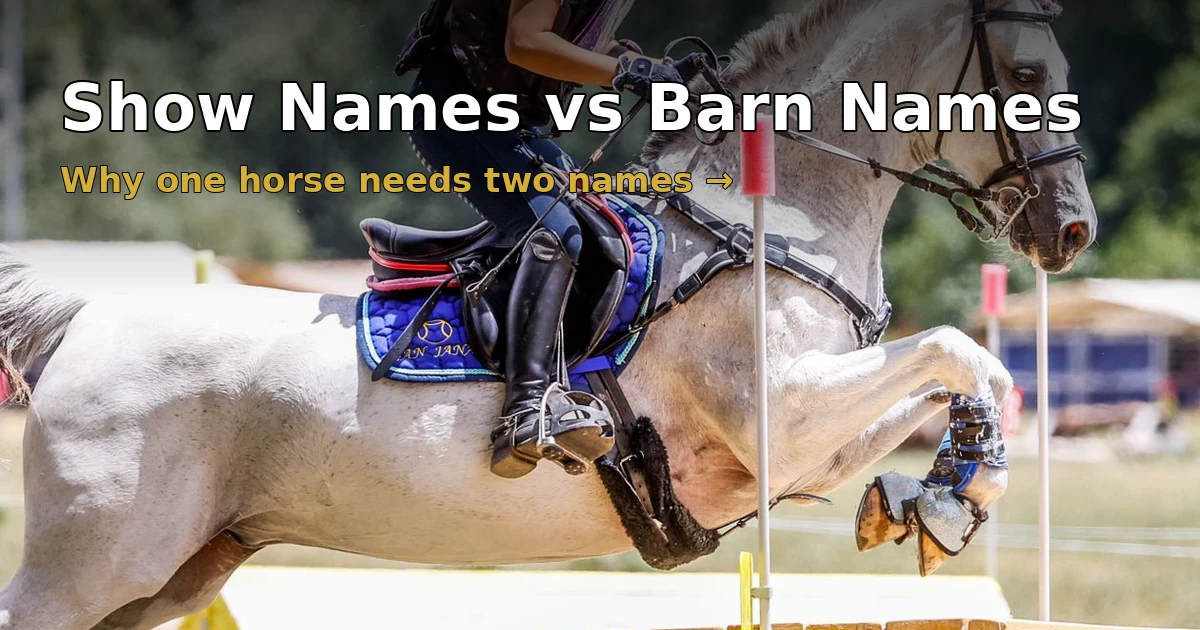
Show Names vs Barn Names: How Horse Naming Really Works
The short answer: most horses have two names because the two names do different jobs. The barn name is the one-word call the horse actually learns — “Maggie.” The show name (usually the registered name) is the formal, unique label on the papers, the entry form, and the results sheet — “Midnight’s Second Chance.” One is for the horse. The other is for the record books.
Stand at the rail at any show and you will hear it within minutes. The announcer calls out something grand — “And now, Chasing Moonlight’s Silver Lining” — and the rider walking into the ring is quietly saying “Come on, Moony.” Same horse. Two names. Nobody at the show thinks this is strange, because in the horse world it is the normal state of affairs.
The two names, one horse
Three terms get thrown around as if they mean the same thing. They do not:
- Registered name: the official name recorded by a breed registry or racing authority. It lives on the papers and in the database, and it has to be unique.
- Show name: the name printed in competition schedules, results, and announcements. It is often the registered name — but not always.
- Barn name: the everyday name used by the owner, trainer, groom, and vet. It can be anything at all. Nobody approves it, and the horse is the only one who has to learn it.
So a horse can be “Maggie” in the barn and “Midnight’s Second Chance” on the results sheet, and both names are correct at the same time. The formal name is not a claim that the horse has a different personality — it is an identification label that travels with the horse from breeder to buyer to show ring, long after the people who knew “Maggie” have moved on.
Here is the part that surprises most people outside the horse world: the horse does not know its show name, and does not need to. A horse learns the sounds and cues that people consistently use — the short barn name, the tone, the routine. If a rider uses the formal name at a show, the horse is responding to the handler’s voice and body language, not to a database entry.
Why show names got so long and so weird
Show names are not long because horse people like long names. They are long because registries ran out of short ones a very long time ago.
Every registry needs each horse’s name to be distinctive and searchable. When thousands of foals are registered every year, “Star” and “Bella” and “Storm” are gone before you even ask. The only way to get a name that is both available and meaningful is to build a phrase — and the phrase usually has to carry a connection to the horse’s pedigree, because that is how breeders, buyers, and judges read a name at a glance.
Then there is the practical side: official names have to fit registration systems, entry forms, catalogues, timing software, and announcers’ screens. That is why registries count letters, spaces, and punctuation so precisely. The weirdness is not decoration. It is what happens when thousands of people try to be original inside a very small box.
The rulebook: Thoroughbreds, Quarter Horses, and warmbloods
There is no single rulebook. Each registry writes its own, and the differences are the whole story. These are the three systems most readers will meet:
Thoroughbreds — The Jockey Club, 18 characters. Every Thoroughbred registered in the United States and Canada is named under Rule 6 of the American Stud Book: 18 characters or fewer, counting spaces and punctuation, and no more than seven syllables. Owners submit up to six choices in order of preference, and roughly 30% of submitted names are rejected. Naming is free if a valid attempt is made before February 1 of the horse’s two-year-old year; after that there is a fee. What gets rejected: names already in use, names of famous or protected horses, names of living people without written permission, commercial names, initials, numbers (unless spelled out, and only above thirty — hence “Forty Niner”), names ending in horse words like “filly,” “colt,” “mare,” or “stallion,” and anything offensive. The reuse rules are strict too: a name cannot be reused if the horse raced or bred within the previous 10 years, a stallion’s name is protected for 15 years after it stops breeding, and a Grade 1 stakes winner’s name is protected for 25 years. That 18-character box is exactly why racehorse names look the way they do — “Seabiscuit” fits; a long clever phrase usually does not, so owners squash words together (“Atswhatimtalkinbout”) and live with the result.
Quarter Horses — AQHA, 20 characters. The American Quarter Horse Association allows up to 20 characters including spaces and numbers, and it is a little more relaxed than The Jockey Club: a foal does not have to be named after its pedigree, though many breeders choose a family connection anyway. Arabic numerals are allowed, but only at the end of the name, with a space before them. Punctuation is not permitted at all — no apostrophes, no hyphens. The Australian AQHA, for the record, allows 25 characters — the same horse can face a different limit depending on which side of the world it is registered.
Warmbloods — the letter is the rule. This is where naming turns into a code. Most German studbooks name foals by the first letter of the sire’s name — Hanoverian, Oldenburg, and Westphalian all work this way (Oldenburg fillies intended for breeding traditionally take the first letter of the dam’s name instead). The Dutch KWPN works differently: each birth year gets a letter, and every foal born that year must start with it — the letters Q, X, and Y are skipped, and the cycle restarts at A. The Belgian Zangersheide registry adds a “Z” to the end of every registered name, which is why they are called “Z horses.” Arabians have their own shape: no more than 21 characters, no more than four parts, and only capital letters, dashes, and spaces. If you are buying a warmblood and the name starts with a letter that seems random, it is not random — it is the studbook telling you the horse’s year, its sire, or its breeder.
One more layer: the breeder’s prefix. Many show names start (or end) with a stud prefix — a registered word that belongs to one breeder, like a surname that comes first. It is how a breeder gets credit every time one of their horses wins, and prefixes have their own registration so two breeders cannot claim the same one.
When the two names collide: the paperwork test
Having two names is easy. Keeping them straight on paper is where people get caught — and in the show world, the paperwork is not a formality.
For USEF-licensed shows, the show name has to be the same name on the show entry, the USEF horse identification or recording documents, the USDF registration, the Coggins test, and the proof of vaccination. If the Coggins certificate lists only the barn name, the vet has to write a letter stating that the horse with barn name A is the same horse as the horse with show name B. The rule exists for a good reason — a Coggins test is a disease-control document, and “Maggie” is not an identity — but it catches new owners every season.
The same logic applies everywhere a horse changes hands: the microchip, the passport, and the vet’s records should all identify the same animal. A name alone is never reliable identification — the chip number, registration number, or competition ID is what actually proves which horse you are looking at.
Can you change a show name? (And a barn name?)
This is the question that decides whether you should agonise over the show name — and the answer is very different for the two names.
The barn name: change it whenever you like. It is a nickname. If you buy a horse called “Brutus” and he turns out to be a gentle soul who answers better to “Biscuit,” rename him on day one and never look back.
The registered name: changing it is hard, sometimes impossible. With The Jockey Club, a name can be changed for a fee before the horse’s first start, provided it has not been bred; once a horse has raced, a change is allowed only for good cause, such as a ruling by the registrar. AQHA allows a name change only while the horse has not competed in an AQHA show or started in a recognised race. And once a horse has a show record under a name, changing it gets harder still — results, points, and prize money are all tied to that name. Some breed and colour associations do not allow a registered name change at all once the papers are issued.
The practical lesson: treat the show name as permanent and the barn name as flexible. Spend your energy getting the formal name right — available, legal, pronounceable by an announcer — and let the barn name be the easy, affectionate part.
How to build a pair that works: the 5-step method
If you are naming a foal, registering a youngster, or just giving a new horse its show-ring identity, build the two names together instead of separately:
1. Start with the barn name, not the show name. Pick the one- or two-syllable call you will actually shout across a field — short, with hard consonants, nothing that rhymes with a command. “Kit” vs “sit” and “Bo” vs “no” will haunt you for years. If you want a head start, our K horse names collection leans on exactly that logic: short barn names first, because the hard “K” carries across a yard.
2. Grow the show name out of the barn name. The classic patterns all work: the barn name inside a phrase (“Daisy” → “Daisy Chain Reaction”), a sire-or-dam echo (“by Crusader out of Dashing Dolly” → “Crusading Doll”), or a pedigree word plus a flourish.
3. Count the characters before you fall in love. Eighteen for a Thoroughbred, twenty for a Quarter Horse, twenty for a KWPN, twenty-one for an Arabian — and spaces and punctuation count everywhere. Most rejected names are not offensive; they are just two characters too long.
4. Say it out loud, the way an announcer would. “And the winner is…” — if you stumble, or if it sounds like a different word when shouted, cut it. Then say the barn name the way you will yell it across a field. If it tangles your tongue, pick something cleaner.
5. Check availability before you print anything. Every registry has a name-availability check — The Jockey Club’s registry, AQHA’s Research Foal Name tool. Run your top three choices through it before you order a stall plate or tell your friends. Availability changes constantly, and a name that was free last year may be taken now.
Two worked pairs, to show the method in action: a chestnut mare called “Ruby” in the barn becomes “Ruby’s Lasting Impression” in the ring — at 25 characters it would need trimming for a Thoroughbred (18) or a KWPN warmblood (20), though it fits the Swedish Warmblood’s 25-character limit. A bay gelding called “Finn” becomes “Finn Again, And Again” — playful, memorable, but at 21 characters it fails the Thoroughbred’s 18-character test, which is exactly the point of step 3: the joke has to survive the ruler.
The famous ones: what the legends teach us
Secretariat’s barn name was “Big Red”; his show name was the formal, 11-character, perfectly countable “Secretariat.” American Pharoah is the cautionary tale: the owner’s intended spelling was “Pharaoh,” the submission went in as “Pharoah,” and the registry accepted what was submitted — a Triple Crown winner ran his entire career under a misspelling, because once a registered name is accepted, it is the name. Check the spelling before you submit — twice. If you want more of the stories behind the famous names, our famous horse names collection is the place to start — and mustang horse names shows the opposite tradition, where the name comes from the land and the horse’s story rather than any registry at all.
Frequently asked questions
Does a horse need both a show name and a barn name?
No — but almost every horse ends up with both anyway. A registered or competing horse needs a formal, unique name for the papers. The barn name is optional in theory and universal in practice, because nobody wants to shout “Midnight’s Second Chance, come here!” across a muddy field.
Can the show name and the barn name be the same?
Yes, and for unregistered horses at schooling shows it is common. But the moment a horse is registered or competes at licensed shows, the formal name usually has to be unique — and “Daisy” is already taken a thousand times over.
How long can a horse’s show name be?
It depends on the registry: 18 characters including spaces and punctuation for Thoroughbreds (The Jockey Club), 20 characters for Quarter Horses (AQHA) and KWPN warmbloods, 21 characters and no more than four parts for Arabians. Always check the current rulebook for your breed — limits do change.
Does my horse know its show name?
Almost certainly not, and it does not matter. Horses learn the sounds people consistently use — the short barn name, the tone of voice, the routine around it. The show name is for the announcer, the entry form, and the record books, not for the horse.
Can I change my horse’s registered name?
Sometimes, and only early. The Jockey Club allows a change before the first start (if the horse has not been bred); AQHA allows it only before the horse has competed or raced. Once a horse has a show record under a name, changing it is difficult or impossible. The barn name, by contrast, can be changed any day.
What is a breeder’s prefix in a show name?
A registered word or set of letters that identifies the breeder — effectively the horse’s surname, usually placed first. Prefixes are registered so no two breeders can use the same one, and the breeder gets recognition every time one of their horses wins.
The bottom line
A horse has two names because two different worlds need to name it. The barn is a world of voices, routines, and one-word calls — it needs a name a horse can learn and a human can shout. The show ring is a world of papers, databases, and announcers — it needs a name no other horse has, that fits a character limit, and that tells the pedigree at a glance. Get the show name right once, because you may never get to change it. Get the barn name right for the horse in front of you, because that is the name that will actually be spoken.
If you are still choosing the everyday half of the pair, start with the lists that match your horse: ranch horse names for working horses with short, carrying calls, Arabian horse names for the breed whose own naming rules are the oldest in the book, and horse names starting with E if you want elegant, energetic, and earthy options in one place. Pick the barn name you love saying. Then count the show name twice.

Hi, I’m Liam
I run Pet Names Lovers — every guide here starts from a question I’d want answered myself, researched properly, and written in plain English. I write, edit, and publish everything myself.