
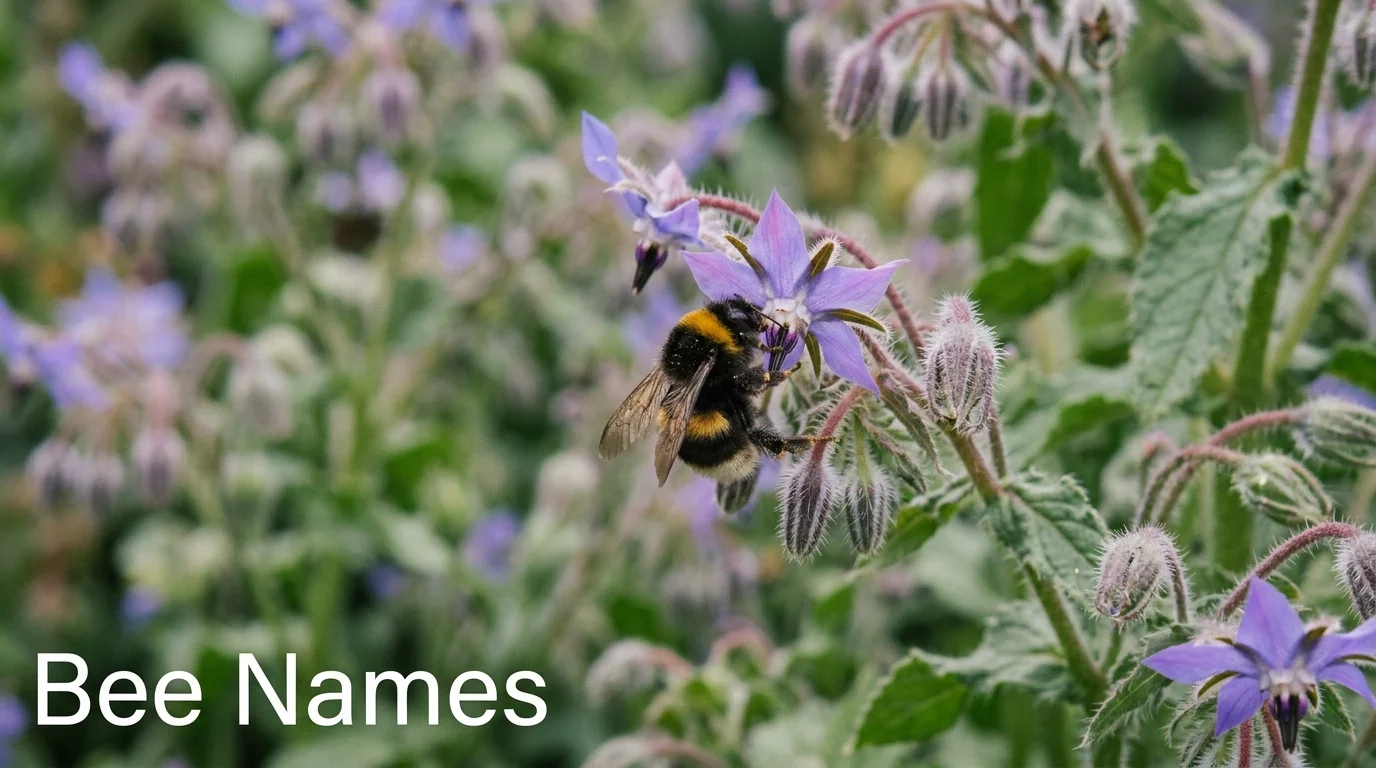
Most bee names end up on a hive or a queen, not on an individual bee, because one worker looks exactly like the next. Clover, Pip, Fuzz, and Eleanor fit either, and the 400+ bee names below are sorted by role, bee type, and theme, with a note beside each.
A strong honey bee colony in midsummer holds tens of thousands of workers, a few hundred drones, and exactly one queen. That head count decides how you name things.
Who Are You Actually Naming When You Name a Bee?
A honey bee colony has three kinds of bee, and each calls for a different kind of name. The queen is the only one you can pick out on sight, which is why she gets the most names.
| Role | Sex | How Many | Typical Life Span | Name Style That Fits |
|---|---|---|---|---|
| Queen | Female | One per colony | Often a few years | Regal or historical |
| Worker | Female | Tens of thousands at summer peak | About five to six weeks in summer, months in winter | Job-based and small |
| Drone | Male | Hundreds, mostly in the warm season | Weeks to a season | Playful, loafing jokes |
Beekeepers often mark queens with a dot of paint, and the color follows a five-year cycle. White is for years ending in 1 or 6, yellow for 2 or 7, red for 3 or 8, green for 4 or 9, and blue for 5 or 0.
A queen raised this year, 2026, would get white. Some keepers name a queen after her dot.
Bee-keeping rules vary by country and region, so check whether your area requires hive registration. The names below work equally well for a mason bee house, a plush, a school mascot, or a story.
What Are Good Female Bee Names?
Worker bees and queens are both female. They just have very different jobs.
What Are Good Names for a Queen Bee?
A queen lays up to roughly 2,000 eggs a day at her peak and may run a colony for a few years, so a name with some weight suits her. Historical queens make honest picks, and each note below is a plain fact.
- Eleanor – Eleanor of Aquitaine, queen of both France and England
- Hatshepsut – an Egyptian woman who ruled as pharaoh
- Nzinga – a 17th-century queen of Ndongo and Matamba, in present-day Angola
- Zenobia – a third-century queen of the Palmyrene Empire
- Tomyris – queen of the Massagetae, according to Herodotus
- Boudicca – led the Iceni revolt against Roman rule around AD 60
- Amanirenas – a queen of Kush who fought Rome
- Artemisia – queen of Halicarnassus, who fought at Salamis
- Dido – the legendary founder-queen of Carthage
- Sheba – the biblical queen who visited Solomon
- Isabella – Isabella I of Castile
- Victoria – Britain’s queen from 1837 to 1901
- Elizabeth – the name of two long-reigning English and British queens
- Matilda – a 12th-century claimant to the English throne
- Liliuokalani – Hawaii’s last reigning monarch, and easy to shorten to Lili
- Wilhelmina – queen of the Netherlands from 1890 to 1948
- Cleopatra – the last active ruler of Ptolemaic Egypt
- Nefertiti – the royal wife of the pharaoh Akhenaten
- Regina – Latin for “queen”
- Reina – Spanish for “queen”
- Reine – French for “queen”
- Malika – “queen” in Arabic
- Rani – “queen” in Hindi
- Queenie – the direct nickname
- Majesty – how you would address one
- Duchess – one step below a queen
- Empress – one step above
- Matriarch – she is the mother of the whole colony
- Mother – nearly every worker in the hive is her daughter
- Dot – for a queen marked with a dot of paint
What Are Good Names for Worker Bees?
Worker bees change jobs as they age. Younger ones clean cells and feed larvae, while older ones guard the entrance and forage.
Job names are the most accurate choice. Given names with a buzzing Z sound fill out the rest.
- Forager – older workers collect nectar and pollen
- Nurse – younger workers feed the larvae
- Scout – some foragers find new flower patches or nest sites
- Sentinel – guard bees at the entrance
- Undertaker – workers carry dead bees out of the hive
- Fanner – workers fan their wings to move air and dry nectar
- Builder – workers make wax and build comb
- Comb – the wax structure of hexagonal cells
- Cell – one hexagonal chamber
- Capper – seals finished honey cells with wax
- Dancer – foragers dance to share where the flowers are
- Waggle – the figure-eight dance that signals direction
- Basket – pollen is carried in baskets on the hind legs
- Propolis – the sticky resin bees use as glue
- Wax – secreted by glands on a worker’s abdomen
- Beebread – pollen packed into cells as food
- Jelly – nurse bees produce royal jelly
- Brood – the developing young
- Swarm – a colony splitting to find a new home
- Courier – carries nectar back to the hive
- Tender – tends the young
- Cleaner – newly emerged workers clean cells
- Packer – packs pollen into storage cells
- Ranger – a forager that flies far from the hive
- Tanker – water carriers haul water on hot days
- Attendant – workers who tend the queen
- Retinue – the workers that surround the queen
- Learner – young bees take short orientation flights
- Winter – autumn-raised workers live for months
- Summer – summer workers live about five to six weeks
- Bea – short for Beatrice, and it sounds like the letter B
- Beatrice – the full, old-fashioned version
- Beatrix – a longer, fancier Bea
- Zoe – Greek for “life”
- Zelda – the Z buzzes
- Zuzu – hums when you say it
- Lizzie – a bit of buzz in the middle
- Dizzy – for the dancing
- Fizzy – bubbly and buzzy
- Hattie – old-fashioned and industrious
- Mabel – a sturdy, old-fashioned name
- Dorothea – Greek for “gift of god”
- Polly – a nod to pollen
- Sunny – for a sunlit forager
- Goldie – for a golden-striped bee
- Marmalade – for the orange-toned worker
- Bijou – French for “jewel”
- Tilly – small and lively
- Maisie – bouncy and small-sounding
- Nell – short and warm
Ant colonies split the work by caste too, so our ant names guide is worth a look if you’re naming those as well.
What Are Good Male Bee Names?
Drones are the male bees. They have no stinger, do not forage, and mate with queens in flight, and colonies typically push them out in autumn.
That gives drone names a natural loafing-and-romance theme. Ordinary given names work well too.
- Drone – plain and accurate
- Romeo – drones exist to find a queen
- Lothario – for the charming, unreliable one
- Duke – a title with no duties, like a drone
- Baron – another title with no duties
- Earl – the same joke again
- Sir Loafs-a-Lot – drones do not forage
- Peeper – drones have larger eyes than workers
- Drifter – drones often wander into other colonies
- Loafer – a bit unfair, but funny
- Lounge – for a bee who never works
- Stingless – drones have no stinger
- Gentle – drones cannot sting
- Wanderer – for the drifter type
- Congregation – drones gather in flying groups to find queens
- Zoom – for the mating flights
- Rendezvous – where the queen meets the drones
- Suitor – the formal version of Romeo
- Charmer – for a smooth flyer
- Dandy – for a tidy, well-dressed bee
- Gadabout – always out and about
- Idler – for a loafing drone
- Buzz – the obvious one
- Barnaby – round and slightly bumbling
- Basil – a herb whose flowers bees visit
- Bertie – friendly and easygoing
- Bram – short and bold
- Cyrus – dignified
- Dexter – Latin for “right-handed” or “skillful”
- Felix – Latin for “happy”
- Gus – short and gruff
- Hugo – short and punchy
- Ike – one easy syllable
- Jasper – a stone that comes in yellow and brown
- Kit – small and quick
- Leo – Latin for “lion”
- Milo – gentle and friendly
- Ned – easy to call
- Oscar – classic
- Percy – proper and polite
- Rufus – Latin for “red-haired,” good for a ginger fuzz
- Silas – old-fashioned
- Theo – short and warm
- Wilbur – a gentle old name
- Zeke – a buzzy Z
What Are Good Names for a Bumblebee?
Bumblebees (genus Bombus) are the fuzzy ones. A queen founds each nest alone in spring, and a nest holds far fewer bees than a honey bee hive.
Names for them lean soft and round.
- Bombus – the genus name, from a word for a buzzing or booming sound
- Fuzz – the plain description
- Puff – for a round, fluffy body
- Pom – like a pom-pom
- Velvet – for the soft, thick hair
- Rumble – for the low buzz
- Thistle – bumblebees love thistles
- Pudge – for a round body
- Gumdrop – small, round, and bright
- Tumble – for a wobbly flight
- Roly – short for roly-poly
- Plump – round and heavy-looking
- Teddy – teddy-bear fuzz
- Flop – for a heavy landing on a flower
- Boom – a deep buzz
- Ember – for a red-tailed bumblebee
- Buff – for the buff-tailed bumblebee
- Garden – the common garden bumblebee
- Carder – the common carder bumblebee
- Ginger – for a ginger-brown coat
- Rusty – after the rusty patched bumble bee, a North American species
- Nest – bumblebees nest in old burrows and grass
- Burrow – often an abandoned rodent burrow
- Hollow – a nesting spot
- Meadow – a favorite habitat
- Hedgerow – good bumblebee habitat
- Vetch – a flower bumblebees visit
- Lupin – another bumblebee favorite
- Sonic – bumblebees shake pollen loose by vibrating their flight muscles
- Shake – the same behavior, plainer
- Tremble – the same, softer
- Whirr – the sound of their wings
- Cushion – soft and plump
- Mohair – for a soft, fuzzy coat
- Fleece – warm and woolly
- Woolly – a plain description
- Shag – for a shaggy coat
- Muff – a fuzzy hand-warmer
- Bumbler – the silly version
- Waddle – for a heavy, wobbly walk
- Cinnamon – a brown, warm color
- Tawny – a warm brown
- Pumpkin – round and orange-yellow
- Dune – sandy and tan
- Hazel – a warm, reddish-brown
What Are Good Bee Names Inspired by Honey?
Honey takes its color and flavor from the flowers bees visit, and there are dozens of named varieties. These names come from real single-flower honeys and honey terms.
- Clover – one of the most common honeys in North America
- Buckwheat – a dark, strong honey
- Orange Blossom – a citrus-flower honey
- Tupelo – from tupelo trees in the southeastern US, and slow to crystallize
- Sourwood – a well-known Appalachian honey
- Acacia – a pale honey that stays liquid for a long time
- Heather – a thick, jelly-like honey
- Manuka – from New Zealand’s manuka bush
- Linden – from linden trees
- Chestnut – dark and slightly bitter
- Thyme – a Mediterranean herb honey
- Sage – a light honey from sage flowers, especially in California
- Eucalyptus – a strong honey from eucalyptus blossoms
- Goldenrod – a late-season honey
- Fireweed – a pale honey from fireweed
- Alfalfa – a mild honey common in the western US
- Wildflower – a mix of whatever was blooming
- Blueberry – from blueberry blossoms
- Raspberry – from raspberry flowers
- Canola – a pale honey from canola fields
- Creamed – honey whipped to a spreadable texture
- Set – honey that has crystallized
- Mead – a fermented honey drink
- Nectar – what forager bees carry home
- Amber – the color of many honeys
- Gold – the color of light honeys
- Molasses – for the darkest honeys
- Ling – an old British name for heather
- Honeydew – a dark honey made from insect honeydew rather than nectar
- Lychee – a floral honey from lychee blossoms
Bears famously raid hives for honey, so our bear names guide is worth a look if the naming spills over.
What Are Good Names for Mason Bees and Other Solitary Bees?
Most bee species are solitary, with each female building her own nest instead of joining a colony. That makes these names good for a nesting box or bee hotel, a block or tube set that gives solitary bees somewhere to lay eggs.
- Osmia – the genus of mason bees
- Mason – mason bees plug nests with mud
- Xylo – short for Xylocopa, the carpenter bee genus
- Carpenter – carpenter bees excavate wood nests
- Cutter – leafcutter bees cut circles from leaves
- Leafy – the friendly version
- Sweat – sweat bees are small and often metallic
- Emerald – some sweat bees are metallic green
- Miner – mining bees nest in the ground
- Tunnel – their nests are tunnels in soil
- Plasterer – plasterer bees line their nests with a waterproof coating
- Cellophane – another name for plasterer bees
- Azure – blue-banded bees have pale-blue stripes
- Orchid – orchid bees are metallic and live in the Americas
- Melipona – a stingless bee genus
- Wool – wool carder bees scrape fuzz from plants
- Resin – resin bees seal their nests with plant resin
- Cuckoo – cuckoo bees lay eggs in other bees’ nests
- Nomad – nomad bees are a kind of cuckoo bee
- Digger – digger bees nest in the ground
What Are Good Bee Names Inspired by Flowers?
Bees visit thousands of plant species. These are garden favorites, and the notes say why each one draws them.
- Lavender – long-blooming and a bee magnet
- Borage – blue star-shaped flowers bees love
- Foxglove – bumblebees crawl inside the bells
- Comfrey – a bumblebee favorite
- Catmint – long-flowering and popular
- Echinacea – coneflowers offer a wide landing pad
- Crocus – an early spring food source
- Snowdrop – one of the first flowers of the year
- Hellebore – winter and early spring flowers
- Willow – early catkins feed spring bees
- Aster – a late-season flower
- Sedum – late-summer flowers
- Phacelia – a popular bee cover crop
- Bugloss – viper’s bugloss is a bee favorite
- Salvia – rich in nectar
- Marjoram – a herb bees visit
- Hyssop – a magnet for bees
- Rosemary – early flowers
- Poppy – offers pollen, not nectar
- Sunflower – a big, open landing pad
- Cosmos – open-faced and easy for bees
- Zinnia – open flowers in late summer
- Dahlia – single-flowered types suit bees best
- Marigold – single-flowered types suit bees
- Nasturtium – bumblebees visit it
- Calendula – open, easy flowers
- Cornflower – a blue bee favorite
- Oxeye – oxeye daisies suit bees
- Buttercup – a spring flower
- Primrose – early spring flowers
- Bluebell – a woodland bee favorite
- Honeysuckle – a sweet, tubular flower
- Jasmine – fragrant and rich in nectar
- Mint – flowers draw bees when allowed to bloom
- Oregano – another herb bees visit
- Fennel – umbrella-shaped flowers
- Dill – the same shape
- Chive – purple pom-pom flowers
- Blackberry – a big nectar source
- Bramble – the hedgerow version of blackberry
- Blossom – for spring flowers on fruit trees
- Hawthorn – spring flowers on a thorny tree
- Ivy – its autumn flowers feed bees late in the year
- Buddleia – the butterfly bush also draws bees
- Verbena – tall flower heads bees visit
If your garden also hosts butterflies, our butterfly names guide covers the other regular visitors.
What Are Some Cute Bee Names?
Cute bee names are short, round, and a little sweet. Keep them to one or two syllables so a child can say them.
Naming other small winged visitors? Our dragonfly names guide has more ideas.
- Pip – tiny and quick
- Button – small and round
- Bean – small and plump
- Speck – a worker is only about half an inch long
- Sprout – a new shoot
- Crumb – small enough to be a snack
- Tuft – a small fuzzy bit
- Nubbin – a small, stubby thing
- Fizz – for a buzzy bee
- Mote – a speck of dust
- Whisper – for the softest hum
- Pebble – small and smooth
- Poppet – an old word for a small, dear child
- Freckle – for a spotted, fuzzy bee
- Biscuit – warm and round
- Waffles – round and sweet
- Pancake – flat and warm
- Cricket – small and jumpy
- Sugarplum – sweet and old-fashioned
- Bitsy – tiny in every way
- Tiny – the plain version
- Twinkle – for a shiny wing
- Sparkle – the same idea
- Pixie – small and magical
- Wisp – light as air
- Snip – small and quick
- Tot – short and small
- Bud – a young shoot
- Bonbon – a small sweet
- Muffin – round and soft
- Nibble – a small bite
- Sweetpea – a sweet, cute name
- Cupcake – small and round
- Truffle – a small sweet
- Thimble – small enough to fit a finger
- Dewdrop – small and shiny
- Petal – soft and light
- Tickle – for a fuzzy bee
- Wiggle – for the waggle dance
- Snuggle – for a soft, fuzzy bee
What Are Good Names for a Newly Hatched Bee?
A bee starts as an egg, hatches into a larva in a wax cell, and pupates under a wax cap. A worker takes about three weeks from egg to adult, and then chews her way out.
- Egg – the first stage
- Grub – a plain word for the larva
- Larva – the technical stage name
- Pupa – the stage under the wax cap
- Cocoon – larvae spin a thin cocoon before pupating
- Capped – sealed in a wax cell
- Newbie – a new adult bee
- Emerge – the moment she comes out
- Hatch – from egg to larva
- Breakout – adults chew through the cell cap
- First Flight – the first orientation trip
- Fresh – just out of the cell
- Dawn – a new beginning
- Peep – a tiny first sound
- Rookie – for a new worker
- Recruit – a new hire
- Cadet – a trainee
- Wriggle – for a larva in a cell
- Pearl – larvae look like small white curved pearls
- Milk – larvae are fed a milky substance called royal jelly
What Are Some Funny Bee Names?
Bee puns run on “be” words and hive jokes. Say each one out loud before you commit, because spelling gags like Bee-Cause only work in print.
- Bee-Have – the order nobody follows
- Buzz Off – rude but affectionate
- Buzzkill – for the party-pooper
- Beeswax – from “mind your own beeswax”
- The Bee’s Knees – an old phrase for “excellent”
- Beeg Deal – “big deal”
- Bee-Cause – “because”
- Bee-Sides – “besides”
- Bee-Tween – “between”
- Bee-Coming – “becoming”
- Bee-Fore – “before”
- Bee Right Back – a polite exit line
- Bee-Ware – a warning
- Beeline – a straight-line flight
- Comb Over – honeycomb plus a hair joke
- Waxing Poetic – beeswax pun
- Honey Do – like the honey-do list
- Honey I’m Home – a sitcom line for a returning forager
- Sticky Situation – honey trouble
- Sting Operation – a police pun
- Hive Mind – a colony joke
- Hive Alive – a rhyme
- Buzz Cut – a haircut pun
- Buzzword – a business pun
- Humdinger – a humming pun
- Hum Drum – a humming pun
- Bombastic – a Bombus pun
- Sir Hums-a-Lot – a fake title
- Duchess of Pollen – a fake noble
- Count Droneula – a vampire pun for a drone
- Pollen Count – hay-fever season
- Pollen Ate – for a well-fed bee
- Nectar Nation – a made-up country
- Waggle Room – like “wiggle room”
- Wing It – improvisation
- Flight Risk – a bee that wanders
- Dizzy Spell – after too much dancing
- Sweet Nothing – something small and honeyed
- Sweet Talker – a smooth operator
- Honey Bunch – a term of endearment
- Sugar Rush – a high-energy bee
- Stripes McGee – a fake surname
- Fuzzy Wuzzy – a fuzzy rhyme
- Sir Stripes-a-Lot – another fake title
- Bee-Nefit – “benefit”
- Bee-Yond – “beyond”
- Bee-Wildered – “bewildered”
- Bee-Witched – “bewitched”
- Bee-Lated – “belated”
- Bee-Gone – “begone”
What Are Some Famous Bee Names?
These are bees from books, film, mascots, and myth. They’re used here as naming inspiration only, and none of these names is affiliated with, licensed by, or endorsed by the studios, companies, or rights holders behind them.
- Maya – Maya the Bee, from Waldemar Bonsels’s 1912 German children’s novel, later adapted into animated series
- Barry – Barry B. Benson, the lead bee in DreamWorks’ Bee Movie (2007)
- Adam – Adam Flayman, Barry’s best friend in the same film
- BuzzBee – the bee mascot of Honey Nut Cheerios
- Bumblebee – a yellow Autobot in the Transformers franchise
- Beedrill – a bee-like Pokémon
- Charmy – Charmy Bee, a character in Sega’s Sonic franchise
- Melissa – Greek for “bee,” and in some myths a nymph who fed the infant Zeus honey
- Aristaeus – a Greek god associated with beekeeping
- Deborah – a Hebrew name meaning “bee,” borne by a judge in the Book of Judges
What Is the Word for Bee in Other Languages?
Bee has ordinary words in many languages, and some make good names on their own. These are the standard words for the insect, not invented translations.
- Apis – Latin for “bee,” and the genus of honey bees
- Mel – Latin for “honey”
- Melitta – an ancient Greek word for a bee
- Abeille – French
- Abeja – Spanish
- Abelha – Portuguese
- Ape – Italian
- Biene – German
- Bij – Dutch
- Pszczoła – Polish
- Mehiläinen – Finnish
- Nyuki – Swahili
- Mitsubachi – Japanese for honey bee
- Hachi – Japanese for bee or wasp
- Arı – Turkish
- Miel – French and Spanish for “honey”
What Are Good Names for a Beehive or Apiary?
A hive name goes on the box, the lid, or the apiary sign. Beekeepers often number or paint hives, and a name lasts longer than a queen, since many keepers replace queens every year or two.
- Bee & Bee – a B&B pun
- Buzz Inn – a hotel pun
- The Waggle Inn – for the dance
- Hexagon Hotel – for the cell shape
- Nectar Lodge – a lodge for foragers
- Apiary Arms – a pub-style name
- Wax Works – for the builders
- Pollen Place – a plain, friendly name
- The Hum Hut – for the sound
- Honey Hold – where the honey is stored
- Sweet Spot – for a well-placed hive
- Comb & Co. – a shop-style name
- Hivemind Manor – for a big colony
- Queen’s Court – for the retinue around the queen
- Royal Jelly House – a fancy name
- Drone Zone – for a hive with a lot of drones
- Sunny Side Hive – for a south-facing box
- Clover Corner – a garden-style name
- Lavender Lane – a garden-style name
- Bramble Cottage – a hedgerow-style name
How Do You Choose Between Bee Names?
Pick the job first, then the name. A queen name, a hive name, and a plush name are three different tasks.
- Decide who you’re naming. Queens and hives are easy to tell apart, individual workers are not.
- Say it out loud. Names with a hard first sound (B, P, T) carry better across a garden.
- Match the name to the role. A queen wants weight, a drone wants a joke, and a hive wants something that fits on a sign.
- Try the nickname. Beatrice becomes Bea and Wilhelmina becomes Mina, so check you like the short form.
- Wait a week. Puns feel great for a day and grate by Friday.
Which Bee Naming Mistakes Are Worth Avoiding?
- Naming individual workers. A summer worker lives about five to six weeks, and you cannot tell one from another, so name the hive.
- Tying a name to one queen. Queens get replaced in many hives, and a hive name outlasts them.
- Naming a look-alike. Hoverflies and some wasps mimic bees, so check before you name your “bee.” Our fly names guide has options if you named a hoverfly by mistake.
- Trusting stinger jokes for drones. Drones cannot sting, so a name like “Stinger” is a joke on the wrong bee.
- Reusing a mascot’s exact name commercially. Character and mascot names can be trademarks, which matters for products more than for a plush at home.
Pick three, say them out loud, and give it a day. The one that still makes you smile is usually the keeper, and you can browse the rest of our animal names if you want more.
Frequently Asked Questions
Clover, Pip, and Fuzz are strong all-rounders because they’re short and echo flowers or fuzz. For a queen, try Eleanor or Dot. For a hive, try Bee & Bee.
Maya (Maya the Bee), Barry and Adam (Bee Movie), BuzzBee (Honey Nut Cheerios), Bumblebee (Transformers), Beedrill (Pokémon), and Charmy (Sonic) are the best known. The full list with notes is in the famous section above.
It’s subjective, but fuzzy bumblebees usually win. The teddy bear bee (Amegilla bombiformis) of Australia is another popular contender.
Not in the way you’d keep a hamster. A honey bee cannot live alone, so keeping bees means keeping a colony, and rules on registration vary by area. Solitary bees, like mason bees, are the low-effort option: put up a nesting box and name the box.