My notebook for draft names has a rule written across the top of the first page, in pencil, because I have had to erase it and rewrite it three times: the name has to survive the gap. The gap is the space between the horse you imagined when you first saw it — two thousand pounds of Belgian, or a feathered-leg Clydesdale stepping like it owns the road — and the horse you actually live with six months later, which leans on you for scratches, steals carrots out of your pocket, and answers to something short enough to shout across a field at feeding time.
The notebook is organised the way a breeder’s notebook is organised, not the way a mythology list is. Male names and female names first, because sex changes what fits. Then the barn names — the short, blunt ones that actually get used every single day, one or two syllables, nothing that gets lost across a paddock. Then the breed pages, because a jet-black Shire and a honey-coloured Belgian are built the same and read completely differently standing in a field, and a name that fits one will look silly on the other. Every name below has its reason written beside it, the way a notebook keeps the reason beside the name, so you can see why it earned its place. One more note from the notebook, before you start: decide early which job the name has to do — paperwork or pasture. A grand registered name sounds wonderful on a show programme and terrible at six in the morning. A barn name sounds wonderful at six in the morning and nowhere else. Pick the job first, and the name follows.
Why Draft Horse Names Work Differently
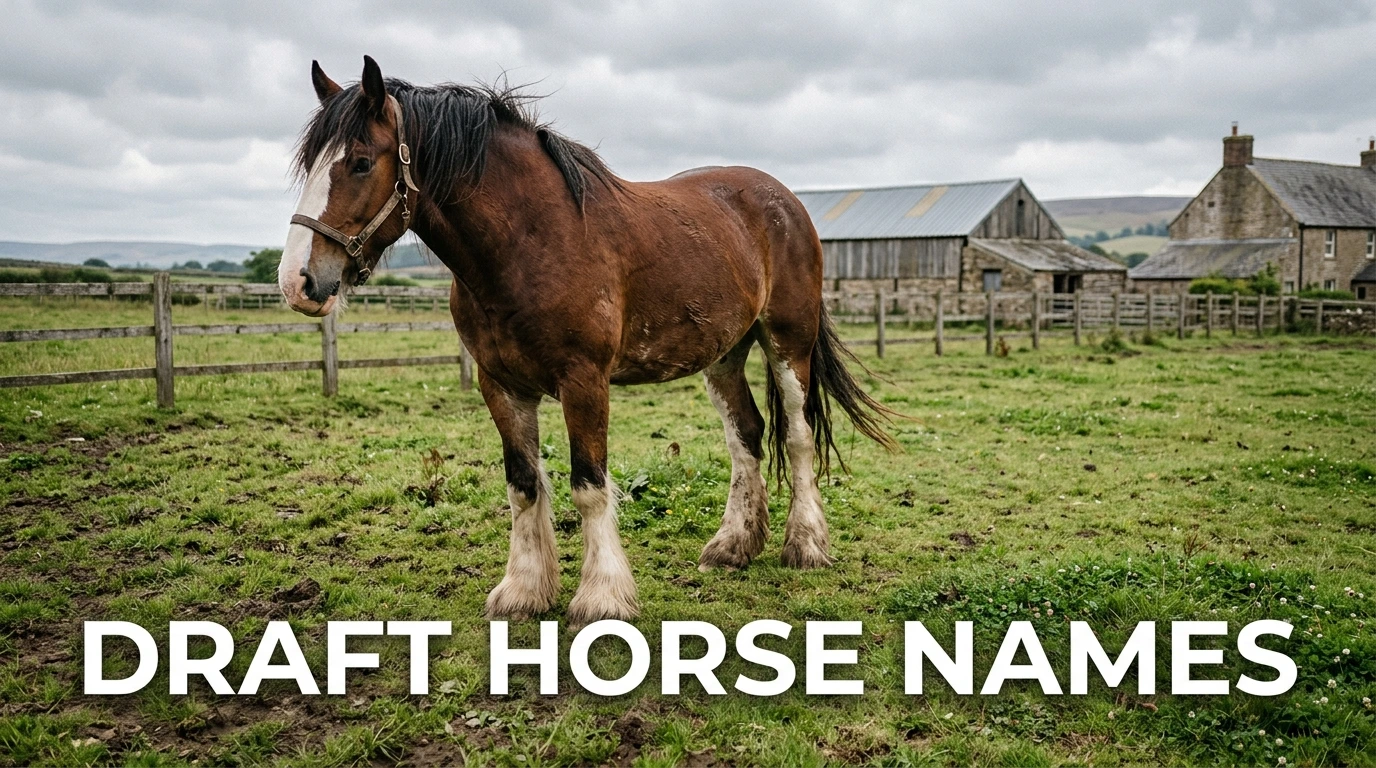
Draft breeds aren’t one look. A Clydesdale carries feathered legs and a bay coat with white markings. A Shire can stand over 18 hands and often comes in black or grey. A Percheron is usually grey or black with a heavier head. A Belgian Draft tends toward chestnut or sorrel with a pale, flaxen mane and tail. A Suffolk Punch is always some shade of chestnut, with no leg feathering at all.
That range matters for naming. A name that fits a jet-black Shire’s size and solemnity can look silly on a honey-colored Belgian who’s built the same but reads completely differently standing in a field.
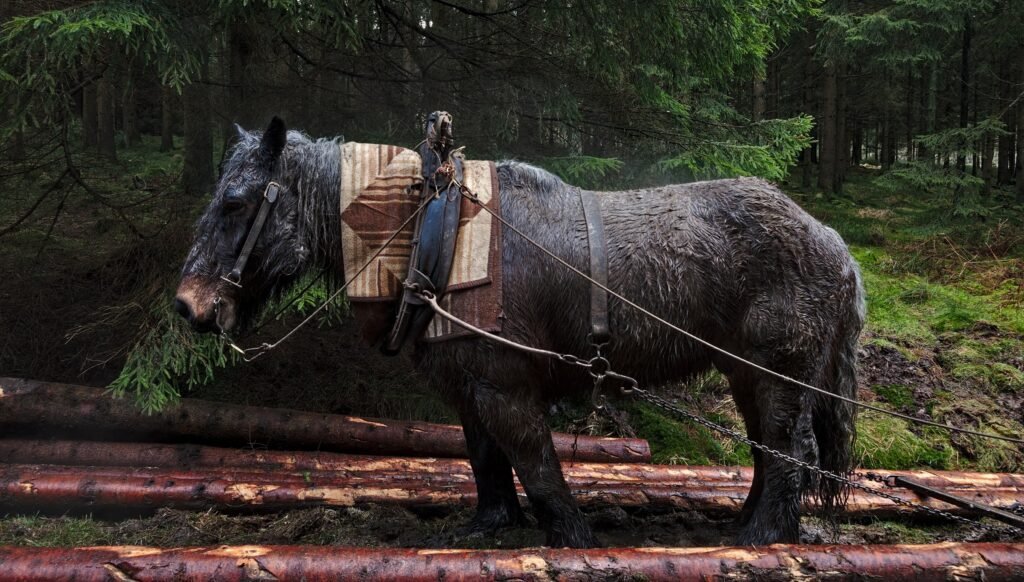
Size changes something else too: these horses get called across open pasture, hitched in teams, and worked all day. A name has to carry over distance and stay clear when you’re shouting it at feeding time with three other horses answering to something similar.
Barn Names vs. Show Names: A Real Draft Horse Convention
Working and show barns often give a draft horse two names a long, formal one for the show ring or the pedigree papers, and a short, blunt one for every single day. A horse registered as “Wellington’s Pride of Ardennes” might answer to “Gus” for the other 364 days of the year.
This isn’t unique to drafts, but it shows up here more than almost anywhere else, because pull and hitch competitions favor grand, impressive names while the actual barn routine favors something you can holler in one syllable. If you’re naming a draft horse, deciding early which job the name needs to do paperwork or pasture saves you from picking something that sounds great on a program and terrible at 6 a.m.
If your horse traces back to English stock, our Shire horse names list digs deeper into that specific breed. And if you want the grand, formal register for a show name, our royal horse names guide leans hard into that territory.
Draft Breeds at a Glance
| Breed | Typical Look | Naming Angle That Fits |
|---|---|---|
| Clydesdale | Bay, feathered legs, white face and leg markings | Scottish heritage, bold and traditional |
| Shire | Often black or grey, tallest of the drafts | Regal, English, oversized-on-purpose |
| Percheron | Grey or black, heavy head, no feathering | French, clean and classic |
| Belgian Draft | Chestnut or sorrel, flaxen mane and tail | Warm-toned, Belgian or golden imagery |
| Suffolk Punch | Always chestnut, no leg feathering | Simple, sturdy, working-farm names |
| American Cream | Cream coat, pink skin, amber eyes | Bright, light-colored imagery |
Names for Male Draft Horses
- Diesel – for a horse that moves like heavy machinery and never seems to run out of gas
- Anvil – blunt, solid, made for a horse that doesn’t flinch
- Clyde – the go-to nod to the Clydesdale breed itself
- Samson – strength name with biblical weight behind it
- Duke – simple title, works on a horse with real presence
- Tank – exactly what it sounds like
- Gunnar – Norse name meaning “warrior,” carries size well
- Ox – one syllable, impossible to mistake at a distance
- Brutus – old Roman name, reads powerful without trying hard
- Wallace – Scottish surname with a rebellious streak
- Angus – Scottish, means “one strength,” fits a heavy-bodied horse
- Baxter – softer sound for a gentle big guy
- Hamish – Scottish form of James, easy to shout
- Fergus – means “man of vigor” in Gaelic
- Magnus – Latin for “great,” about as direct as name meanings get
- Otto – short, German, means “wealth” but sounds solid regardless
- Gideon – biblical name meaning “mighty warrior”
- Sherman – old-fashioned, sturdy-sounding surname
- Cyrus – Persian royal name, means “sun” or “throne”
- Boone – frontier name, fits a working farm horse
- Colt – a wink at irony, since this horse is anything but small
- Hank – plain, farmhand-friendly, easy to call
- Roscoe – old-fashioned, a little goofy, fits a gentle giant
- Cormac – Irish, means “son of the chariot”
- Declan – Irish, strong sound without being over the top
- Bram – short form of Abraham, blunt and solid
- Fenwick – English surname meaning “fen farm,” fits a working horse
- Ulric – Old German, means “wolf power”
- Redmond – Irish, means “wise protector”
- Marshal – a title-name that suits a horse who leads the team
- Stonewall – nod to sheer immovability
- Rigby – short, punchy, easy in a paddock
- Brock – Old English for “badger,” blunt and sturdy
- Dax – short, modern, breaks from the classic-name pattern
- Grover – old-fashioned and warm, good for a mellow horse
- Hutton – English place-name surname, solid and understated
- Kendrick – Welsh, means “greatest champion”
- Lachlan – Scottish, means “from the land of lakes”
- Maddox – Welsh, means “son of benefit” or “fortunate”
- Nolan – Irish, means “champion” or “noble”
- Percy – old English name, a light echo of “Percheron” without naming the breed outright
- Quill – short, unexpected on a heavy horse, memorable for it
- Rufus – Latin for “red-haired,” fits a chestnut or sorrel coat
- Sawyer – occupational surname, fits a working-farm horse
- Tobias – biblical, means “God is good,” soft under a big frame
- Vance – short, sharp, easy to call across a field
- Wyatt – frontier-sounding, one clean syllable to shout
- Zane – modern, short, stands out from the classic-name crowd
- Argus – Greek, the many-eyed giant, fits a watchful gentle horse
- Beckett – English surname, literary weight without pretension
- Cassius – Roman, strong sound, historically tied to strength and stubbornness
- Drummond – Scottish clan name, heavy and traditional
- Ezra – Hebrew, means “help,” soft contrast to a huge build
- Flint – sharp, blunt, one syllable
- Grady – Irish, means “noble” or “illustrious”
- Hollis – English, means “near the holly trees,” gentle sound
- Ivor – Scandinavian-Welsh, means “archer” or “warrior”
- Barnaby – old English, warm and a little old-fashioned
- Crockett – frontier surname, fits a working draft on a farm
- Doyle – Irish, means “dark stranger,” blunt sound
Names for Female Draft Horses
- Matilda – Germanic, means “battle-mighty,” rare case of a name meaning matching the horse’s actual build
- Brunhilde – Norse-German, warrior-queen name, holds up on an 1,800-pound mare
- Juno – Roman queen of the gods, commanding without being harsh
- Clover – soft, farm-flavored, easy on a chestnut coat
- Duchess – title-name, common in draft barns for good reason
- Marigold – bright, warm-toned, suits a golden or sorrel coat
- Bramble – short, textured sound, fits a working farm mare
- Fern – plain, green, grounded
- Wren – small bird name on purpose, the contrast is the point
- Magnolia – Southern, soft, carries well when shortened to “Maggie”
- Nettle – sharp-sounding, good for a mare with attitude
- Rosalind – means “pretty rose,” softens a heavy-bodied horse
- Sable – dark, sleek-sounding name for a black or bay mare
- Tansy – old farm-flower name, understated
- Winifred – Welsh, means “blessed peacemaking,” shortens to “Winnie”
- Agatha – Greek, means “good,” old-fashioned charm
- Bertha – German, means “bright,” historically common on big farm mares
- Constance – means “steadfast,” fits a dependable working horse
- Delphine – French, means “from Delphi,” a little grand
- Edith – Old English, means “prosperous in war”
- Freya – Norse goddess name, strength and beauty combined
- Gwendolyn – Welsh, means “white ring” or “fair and blessed”
- Harriet – means “home ruler,” steady and dignified
- Ida – short, old Germanic, means “hardworking”
- Josephine – means “God will increase,” regal without trying hard
- Katya – Russian, warm diminutive, easy to call
- Lorna – Scottish literary name, unusual on a horse in a good way
- Maude – old English, blunt, grandmotherly charm
- Nora – short form of Honora, means “honor”
- Odessa – place-name feel, striking on a grey mare
- Prudence – Puritan virtue name, dry humor on a huge horse
- Quinta – Latin, means “fifth,” useful if she’s the fifth foal on the farm
- Ruthie – warm, plain, friendly-sounding
- Saoirse – Irish, means “freedom,” pronounced “SEER-sha”
- Thistle – Scottish plant name, prickly and memorable
- Ursula – Latin, means “little bear,” fits a broad-bodied mare
- Vesta – Roman hearth goddess, warm and grounding
- Wilhelmina – means “resolute protector,” shortens to “Willa”
- Ximena – Spanish, means “listener,” soft sound with an unusual look
- Yolanda – Greek origin, means “violet flower”
- Zelda – German, means “grey battle maiden”
- Adelaide – means “noble kind,” shortens to “Addie”
- Bess – short, plain, farmhand-friendly
- Cordelia – Shakespearean, means “heart” or “daughter of the sea”
- Dorothea – Greek, means “gift of God”
- Elowen – Cornish, means “elm tree,” earthy and unusual
- Florentine – means “flourishing,” soft grandeur
- Griselda – old Germanic, means “grey battle,” a mouthful that works on a grey draft mare
- Hazel – tree and color name, fits a brown mare naturally
- Imogen – Shakespearean, means “maiden,” graceful contrast to a big frame
- Junia – Latin, feminine of June, warm-sounding
- Kerensa – Cornish, means “love” or “affection”
- Lavinia – Roman, associated with founding legends
- Marnie – short, modern, friendly to shout
- Nessa – short form of Vanessa or Agnes, easy and warm
- Ottoline – old-fashioned, distinctive, hard to confuse with another horse’s name
- Petra – Greek, means “rock,” blunt strength for a mare
- Rowena – Old English, means “famous friend”
- Seraphina – Hebrew, means “fiery ones,” grand for a show name
- Tallulah – Choctaw origin, means “leaping water,” bright and unusual
- Valentina – means “strong, healthy,” direct and warm
- Bridie – Irish, diminutive tied to Brigid, short and sturdy
Barn Names: Short, Everyday, Easy to Shout
These are the names that actually get used every single day — one or two syllables, nothing that gets lost across a paddock.
- Gus – short, warm, the classic gentle-giant name
- Moe – one syllable, carries well outdoors
- Pip – small-sounding on purpose, funny contrast
- Rex – old standby, means “king,” easy to call
- Belle – simple, soft, works on almost any mare
- Dot – blunt and short, memorable for a big horse
- Biscuit – warm, food-adjacent, common in working barns
- Peach – soft color name, fits a lighter coat
- Nutmeg – warm spice name, good for a bay or chestnut
- Buttons – playful, short, easy to shout
- Chip – blunt, one syllable
- Daisy – classic farm-mare name for a reason
- Ember – short, warm-toned, fits a red or chestnut coat
- Finn – Irish, short and clean
- Goose – blunt, funny, hard to forget
- Honey – warm color name for a golden or palomino-adjacent coat
- Iris – short flower name, clean sound
- Jet – blunt color name for a black horse
- Kip – short and sharp, easy across distance
- Lulu – playful, easy to call twice in a row
- Milo – short, warm, currently common but still clean
- Nell – old-fashioned, blunt, one syllable
- Ollie – friendly, easy on a young gelding
- Pumpkin – seasonal, warm, common on chestnut coats
- Queenie – blunt title-nickname
- Rudy – short, warm, old-fashioned charm
- Sadie – friendly, common, easy to shout
- Tater – farm-flavored, funny, hard to take too seriously
- Uma – short, clean, stands out from the crowd
- Vinny – blunt, working-farm energy
- Willow – tree name, soft but not fussy
- Yogi – short, playful, bear-adjacent for a big horse
- Ziggy – short, energetic, breaks the mold
- Bo – one syllable, about as easy to shout as names get
- Chuck – blunt, farmhand-friendly
- Dixie – short, Southern, old barn-name standard
- Elsie – old-fashioned, soft, easy to call
- Frankie – warm, friendly, gender-neutral in practice
- Ginny – short, warm, classic barn-mare name
- Hobbes – short, a little literary, easy to shout
- Ivy – short plant name, clean sound
- Jax – blunt, modern, sharp across a field
- Kiwi – short, unexpected, memorable
- Lacey – soft, common, easy to call
- Maple – tree name, warm-toned, fits a chestnut coat
- Ned – blunt, old-fashioned, farmhand energy
- Opal – short gem name, clean sound for a grey
- Patch – blunt, descriptive, fits a horse with markings
- Stormy – short, moody, fits a grey or dark-coated horse
Show and Hitch Names: Big, Formal Register
For the program, the pedigree, or a competition hitch team — names built to sound impressive read off a card.
- Sovereign – outright royal weight
- Grandeur – blunt, means exactly what it says
- Excalibur – legendary, dramatic, works best used sparingly
- Monarch – title-name, direct and grand
- Regal – simple adjective turned name
- Imperial – borrowed from empire language, heavy on purpose
- Valor – virtue name, courage-focused
- Sterling – means “of the highest quality,” works as both name and compliment
- Majesty – blunt grandeur, common on show-hitch programs
- Dominion – means “rule” or “territory,” heavy and formal
- Paragon – means “a model of excellence”
- Triumph – victory name, works well for a competition horse
- Vanguard – means “leading position,” fits a lead horse in a hitch
- Ascendant – rising, climbing, forward-looking
- Centurion – Roman military rank, disciplined and grand
- Nobleman – title-name, straightforward grandeur
- Statesman – dignified, works for an older, steady gelding
- Chancellor – political title, formal and weighty
- Baronet – British hereditary title, one step below full nobility
- Highlander – nods to Scottish draft heritage without naming a breed outright
- Ambassador – diplomatic, dignified, good for a calm demeanor
- Wellington – British military and place-name history
- Buckingham – palace name, about as grand as it gets
- Camelot – legendary kingdom, dramatic on a show program
- Windsor – British royal surname
- Coronet – means “small crown,” fits a horse with a white leg marking of the same name
- Pinnacle – means “highest point,” straightforward
- Zenith – astronomical term for the highest point in the sky
- Regent – ruler-in-waiting, formal
- Marquis – French noble rank
- Viscount – British noble rank, works well shortened to “Vice”
- Peerless – means “without equal,” bold claim for a show ring
- Lionheart – nods to courage and King Richard I’s nickname
- Ironclad – naval armor term, means dependable and tough
- Steelheart – modern-sounding, blunt strength
- Anchorman – steady, dependable, works for a wheel horse in a hitch
- Founder – means the one who starts something, works for a farm’s first draft horse
- Cornerstone – foundational, steady, blunt meaning
- Bedrock – means the solid base under everything else
- Keystone – the stone that holds an arch together
- Milestone – marks progress, works for a horse born at a turning point on the farm
- Landmark – means something notable and permanent
- Cavalier – historically a mounted soldier, means gallant and bold
- Trailblazer – means the one who goes first
- Frontrunner – leads the pack, works well for a lead hitch horse
- Pacesetter – sets the pace for the team behind it
Names Inspired by Draft Horse Heritage
Draft breeds trace back to specific countries, and leaning into that heritage without naming the breed outright gives a name real roots instead of a generic grab from mythology.
Scottish-inspired (for Clydesdale lines):
- Ailsa – means “elf victory,” soft Scottish sound
- Bonnie – means “pretty,” classic Scottish nickname
- Callum – means “dove,” gentle contrast to a big frame
- Ewan – means “born of the yew tree”
- Fiona – means “fair” or “white,” fits a grey coat
- Grahame – Scottish surname, means “gravelly homestead”
- Isla – named for the Scottish river
- Keir – means “dark-skinned” or “dusky,” fits a bay or black coat
- Lomond – named for Loch Lomond
- Moira – means “destiny” or “fate”
- Niven – means “little saint”
- Rory – means “red king,” fits a chestnut coat
English-inspired (for Shire and Suffolk Punch lines):
- Alfred – means “wise counsel,” an old English royal name
- Beatrix – means “she who brings happiness”
- Cedric – old English literary name, means “kind leader”
- Doris – means “gift of the ocean” via Greek roots, common old English name
- Edmund – means “wealthy protector”
- Florence – means “flourishing”
- Godfrey – means “God’s peace”
- Hetty – short form of Henrietta, farmhouse-warm
- Ipswich – Suffolk town name, blunt regional nod
- Joan – plain, strong, historically common
- Kentish – regional adjective turned into a name
- Leofric – old English, means “beloved ruler”
- Millicent – means “strong in work,” genuinely fitting for a draft mare
French-inspired (for Percheron lines, named for the Perche region):
- Colette – means “victory of the people”
- Beaumont – means “beautiful mountain”
- Perrine – feminine form tied to Perrin, common in Normandy
- Etoile – means “star”
- Fontaine – means “fountain” or “spring”
- Lucien – means “light”
- Marceau – French surname, blunt and clean
- Noelle – means “Christmas,” warm and bright
- Perche – a direct nod to the Percheron’s home region
- Renaud – old French form of Reynold, means “advisor”
- Solange – means “solemn” or “dignified”
- Theodore – means “gift of God”
Belgian-inspired (for Belgian Draft lines):
- Brielle – Dutch place-name, soft and short
- Dries – Flemish short form of Andreas
- Elke – Dutch-Flemish, means “noble”
- Guyot – old Belgian-French surname
- Hilde – means “battle,” blunt and short
- Jorik – Flemish form of George, means “farmer”
- Kato – Flemish diminutive, short and warm
- Liese – short form of Elisabeth
- Merel – Dutch, means “blackbird”
- Niels – Scandinavian-Flemish crossover, means “champion”
- Odile – means “wealthy,” old Frankish roots
- Wouter – Dutch-Flemish, means “powerful warrior”
Big and Gentle: Names That Play on the Size
Owners of huge, mellow horses tend to lean into the size instead of fighting it. These work best on a horse whose personality is nothing like its footprint.
- Cliffside – for a horse that looks like part of the landscape
- Bigfoot – classic joke name for feathered, oversized hooves
- Chunk – blunt, affectionate, self-explanatory
- Sasquatch – folklore giant, works on a shaggy-coated draft
- Yeti – same idea, fits a lighter or grey coat
- Timber – logging term, fits a horse built for pulling
- Boulder – blunt, immovable, self-descriptive
- Haystack – farm-flavored size joke
- Barrel – blunt shape description, works for a broad-bodied horse
- Loaf – short, funny, works well on a lazy gentle giant
- Tugboat – small, powerful vessel that pulls far more than its size suggests
- Freight Train – unstoppable momentum, fits a working draft
- Steamroller – flattens everything in its path, gently, of course
- Bulldozer – blunt machinery name for maximum size irony
- Backhoe – farm equipment name, works on a literal working horse
- Forklift – funny, modern, machinery-adjacent
- Anchor – heavy, steady, grounding
- Ballast – nautical weight term, means steadying weight
- Slugger – baseball term, blunt power reference
- Chunkster – affectionate, a step past “Chunk”
- Wideload – trucking term for an oversized haul, self-explanatory on a draft
- Big Country – open, expansive, fits a horse who fills a field
- Heavyweight – boxing-adjacent, blunt size reference
- Bulk – one word, no explanation needed
- Boxcar – train-car size reference, fits a working farm horse
- Grizzly – bear name, fits a broad, shaggy-coated horse
- Kodiak – Alaskan bear breed, bigger version of the same idea
- Sycamore – tree name, tall and broad
- Oak – tree name, blunt and grounded
- Cedar – tree name, warm and sturdy sound
- Juggernaut – means an unstoppable force, dramatic and accurate
- Behemoth – biblical giant creature, about as direct as it gets
- Big Softy – for the horse whose personality doesn’t match the frame at all
- Colossus – Greek statue reference, works for the tallest horse in the barn
- Mammoth – prehistoric giant, straightforward size nod
How to Choose a Name From This List
Start with the job the name needs to do. A show or hitch-team horse needs something that reads well on a program; a farm or pasture horse needs something you can shout once and have it land. Trying to make one name do both jobs usually means it does neither well.
Say it out loud across a real distance before committing. Draft horses live outdoors and work in open space, so a name that sounds good in your kitchen might get lost the second you’re fifty feet away at feeding time.
Think about the whole team, not just this one horse. If you’re naming a hitch pair or a barn full of drafts, avoid names that rhyme with or sound like another horse’s Blaze and Grace called across a field turn into the same noise fast.
Common Mistakes People Make Naming a Draft Horse
The biggest one is picking a name based purely on size before you’ve spent real time with the horse. Plenty of draft horses turn out shy, silly, or downright lazy, and a name like “Colossus” can end up feeling like a joke at the horse’s expense rather than a fit.
Another common miss: choosing a name that sounds too close to a common barn command. “Whoa,” “ho,” and “go” all rhyme with more names than people expect, and a horse that hesitates at its own name during work isn’t a training problem it’s a naming one.
Last one worth flagging: duplicating a name already used in the barn, even a nickname. Two horses answering to some version of “Buddy” creates confusion at exactly the moments feeding, loading, emergencies — when clarity actually matters.
Picking the Name That Fits
Here is the warning the notebook carries on its last page, and it is the only one that matters. A grand registered name will look wonderful on a show programme — and it will sound terrible at six in the morning, in the rain, with three other horses answering to something similar. A barn name will sound wonderful at six in the morning — and nowhere else. The horse that leans its full weight on your shoulder for a scratch does not care which one you picked. The person shouting across the pasture does. Choose the job first, paperwork or pasture, and let the name follow it. Get that backwards and you will spend years calling a marshmallow by a thunderstorm’s name.
If you’re weighing this against other big, working-breed names, our warhorse names list leans into a similar strength-first angle, and our western horse names guide covers the working-farm register from a different direction. For the broader pools this article draws its male and female lists from, our male horse names and female horse names guides go even wider.
Frequently Asked Questions
Many working and show barns give a draft horse a formal registered name for pedigree papers or the show ring, and a shorter barn name for daily use. A horse might be entered as something grand and answer to a one-syllable nickname every other day of the year.
Belgian and Flemish-rooted names Dries, Elke, Hilde, Wouter echo the breed’s home country. Warm-toned names like Honey or Marigold also fit well, since Belgian Drafts typically have chestnut or sorrel coats with a flaxen mane.
Names built around blunt strength Anvil, Samson, Tank, Ox suit the build directly, while heritage names like Angus or Magnus carry strength through meaning instead of sound alone.

Hi, I’m Liam
I run Pet Names Lovers — every guide here starts from a question I’d want answered myself, researched properly, and written in plain English. I write, edit, and publish everything myself.
5 thoughts on “300+ Draft Horse Names for Every Breed, Build, and Barn”