
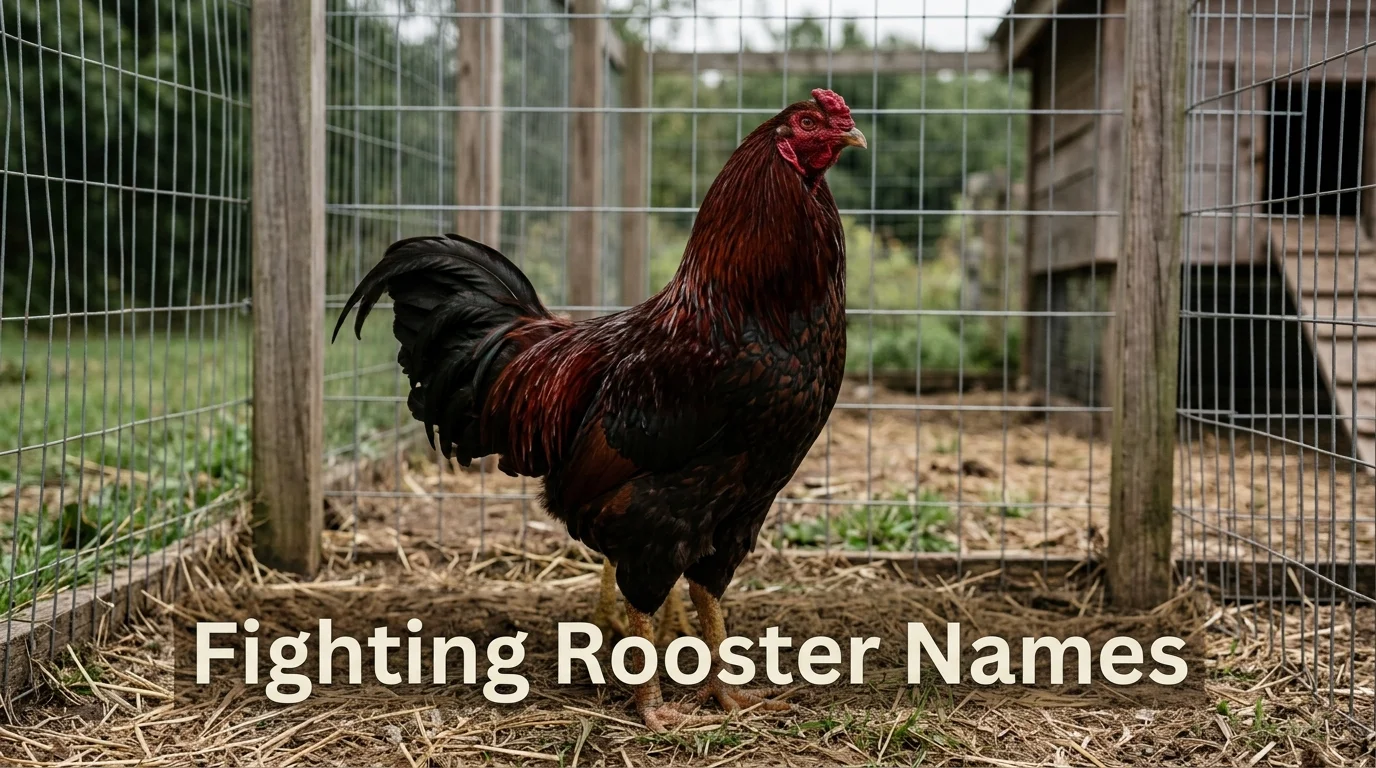
A rooster bred for a fighting stance carries himself differently than a backyard layer’s guard bird, which is exactly why fighting rooster names tend to lean into bloodline, attitude, or sheer nerve instead of something soft.
Whether you’ve got a gamefowl-breed bird kept for showing, breeding, or flock protection, the name usually needs to match a posture that’s already there.
A Quick Word Before the List
This page is about naming, not about the pit. Cockfighting itself is a federal felony everywhere in the United States, territories included, as of a law that took full effect in December 2019. Plenty of people still keep gamefowl breeds like Old English Game or American Game legally, for showing, breeding heritage lines, or simply because they make sharp, alert flock guardians, and that’s who this list is for.
Gamefowl Strains and the Naming Style Behind Them
| Strain Name | Known For | Name Style It Suggests |
|---|---|---|
| Kelso | Aggression, sharp reflexes | Bold, single-word warrior names |
| Hatch | Speed and stamina | Motion-based names |
| Sweater | High-flying strikes | Sharp, punchy names |
| Roundhead | Adaptability, tactical fighting | Strategy or command names |
| Whitehackle | Straight-combed, pale hackles | Light-color names |
| Claret | Deep red plumage | Wine and blood-red color names |
Naming a Rooster From His Actual Strain
Gamefowl in the U.S. are grouped by strain rather than just breed, and the strain names themselves have history behind them. Kelso traces back to breeder Walter Kelso; Sweater is named for Herman “Sweater” McGinnis, who earned the nickname from a red knit sweater he wore to a match in 1926.
That history is exactly why strain names double as ready-made rooster names. A bird from Roundhead stock suits “Roundhead” itself, or a name that nods to strategy and command.
- Kelso – after breeder Walter Kelso
- Hatch – a long-running American strain known for stamina
- Sweater – named for a breeder’s red sweater
- Roundhead – named for the strain’s rounder comb type
- Whitehackle – named for its pale neck feathers
- Claret – named for its deep wine-red plumage
- Butcher – after breeder Phil Marsh’s line
- Albany – a strain traced to a New York breeding line
- Grey – a strain known for grey plumage
- Radio – a strain often crossed with Grey stock
- Lemon – a strain with pale, lemon-toned feathers
- Jumper – nods to noted Kelso breeder Johnny Jumper
- Marsh – nods to breeder Phil Marsh
- Fowler – for anyone tracing lineage through a noted breeder
- Yellowleg – for a bird with yellow-legged coloring
- Redquill – for reddish wing quills
- Darkhackle – for dark neck feathers
- Longspur – for a bird with long leg spurs
- Ironhackle – tough, metallic-sounding neck feathers
- Brownback – for brown saddle feathers
- Steelfeather – for a grey-blue sheen
- Copperhackle – for copper-toned neck feathers
- Pitmaster – for an experienced, battle-tested look
- Lineage – for tracing a strong bloodline
- Pedigree – for a documented family line
- Legacy – for continuing a breeder’s line
- Heirloom – for an old, preserved strain
- Strain – blunt and literal
- Champion – for a proven line
- Purebred – for a strain kept clean of crosses
- Thoroughbred – for a strain bred with precision
- Heritage – for an old-world bloodline
- Sire – for a strong breeding rooster
- Patriarch – for the head of a bloodline
- Founder – for the first bird in a new line
Badass and Warrior Rooster Names
A rooster’s stance alone, chest out, spurs ready, earns names built around battle and grit before anything cute even gets considered.
- Titan – built on raw size
- Brutus – blunt and forceful
- Ragnar – a Norse raider’s name
- Maximus – gladiator-grade
- Spartan – armored, disciplined
- Warlord – commands the yard
- Onslaught – relentless pressure
- Reckoning – a settling of scores
- Vendetta – long-held grudge energy
- Tyrant – rules without asking
- Conqueror – takes ground and keeps it
- Marauder – roams and raids
- Renegade – answers to no one
- Outcast – fierce on his own terms
- Berserker – fights past fear
- Vanguard – leads the charge
- Sentinel – always watching
- Crusader – fights for a cause
- Executioner – finishes what he starts
- Avenger – settles the score
- Rampart – a wall no one gets past
- Ironjaw – a grip that doesn’t let go
- Bloodfang – sharp and merciless
- Razorback – edged and dangerous
- Warhammer – heavy, blunt impact
- Bulldozer – flattens what’s in front of him
- Juggernaut – unstoppable momentum
- Ravager – leaves nothing standing
- Stormbringer – chaos on arrival
- Ironwill – refuses to back down
- Grimm – dark and unyielding
- Barbarian – raw, untamed strength
- Centurion – disciplined and commanding
- Legionnaire – part of something bigger
- Overlord – answers to no rooster
- Highlander – rugged and enduring
- Wolfsbane – dangerous to cross
- Thunderstrike – sudden, loud impact
- Firebrand – lights up a fight
- Ironclad – armored temperament
- Bruiser – built for contact
- Tank – slow to move, hard to stop
- Diesel – runs on raw power
- Colossus – towers over the flock
- Apex – top of the pecking order
Male Fighting Rooster Names
Short, hard-edged names tend to work best here since they’re the ones you’ll actually call out across a yard.
- Duke – noble and commanding
- Bruno – blunt, strong-sounding
- Bear – heavy and imposing
- Rocco – sharp, Italian-rooted
- Bronson – tough, surname-style
- Jax – short and punchy
- Cade – simple, strong-sounding
- Gunnar – Norse, battle-associated
- Hawke – sharp-eyed predator
- Sterling – hard, valuable metal
- Cassius – a name tied to boxing history
- Ali – a name tied to fighting legacy
- Rex – “king,” plain and blunt
- Hunter – always on alert
- Ryder – forward, driving energy
- Slate – hard, flat, unshakeable
- Chase – quick and pursuing
- Colt – young but already fast
- Blaze – fierce and fast
- Ranger – patrols his own ground
- Beckett – sharp, surname-style
- Cruz – quick-moving
- Knox – short, fortress-like
- Maddox – tough-sounding, modern
- Roman – built like a soldier
- Sawyer – rugged, working-name feel
- Kingston – commanding presence
- Zane – short and sharp
- Axel – mechanical, forceful
- Beau – handsome but still tough
- Gage – measured, deliberate
- Kane – hard-edged, biblical root
- Stone – unmovable
- Wilder – untamed
- Bishop – commands respect
Female Fighting Rooster Names
Hens from gamefowl lines carry their own sharpness, and plenty of breeders keep them specifically for continuing a strong strain.
- Xena – warrior-coded
- Boudica – led a rebellion
- Artemis – hunter and protector
- Diana – fierce huntress
- Scarlett – bold and bright
- Ruby – hard, deep red
- Vixen – sharp and cunning
- Tempest – a storm in motion
- Nova – sudden, bright burst
- Raven – dark and watchful
- Cleo – short for a commanding name
- Shera – warrior-coded, powerful
- Electra – sharp, electric energy
- Amara – strong and enduring
- Zara – sharp, modern sound
- Selene – calm but commanding
- Morrigan – a battle-associated figure in Irish myth
- Brianna – strong, noble-rooted
- Kali – fierce, destructive energy
- Ember – glowing, persistent heat
- Blitz – fast and sudden
- Ripley – tough, no-nonsense
- Sable – dark and sleek
- Fury – unfiltered intensity
- Vesper – sharp evening presence
- Harlow – modern and bold
- Juno – commanding, regal
- Nyx – night-associated, quiet power
- Cinder – tough, fire-forged
- Wren – small but sharp
- Frost – cold, unshaken
- Onyx – dark and hard
- Piper – sharp-voiced
- Storm – sudden and forceful
- Indira – strong, commanding root
Mythology and Legend-Inspired Rooster Names
Roosters have a long-standing symbolic tie to courage and vigilance across cultures, which makes myth-based names feel earned rather than random.
- Zeus
- Ares
- Achilles
- Hector
- Mars
- Odin
- Thor
- Loki
- Freya
- Athena
- Perseus
- Hercules
- Atlas
- Apollo
- Vulcan
- Hades
- Anubis
- Osiris
- Ra
- Set
- Sekhmet
- Quetzalcoatl
- Fenrir
- Cerberus
- Chimera
- Griffin
- Phoenix
- Valkyrie
- Minotaur
- Poseidon
Funny Rooster Names
Not every rooster needs to sound like he’s headed into battle. Plenty of owners want the coop to sound a little ridiculous every morning instead.
- Cluckingham
- Featherweight
- Ruffles
- Beakon
- Yolkster
- Combover
- Wattlesworth
- Cocky McCockface
- Fowl Play
- Crow Magnon
- Henspecked
- Struttington
- Chairman Cluck
- Sergeant Squawk
- Wing Commander
- Plumewhacker
- Beaky Blinder
- Sir Ruffington
- Crowbar
- Chicklet
- Clawdius
- Peckerhead
- Combscratcher
- Spurlock
- Wattlejack
- Roostavelt
- Cluckzilla
- Squawkasaurus
- Doodle Dandy
- Crowzilla
- Beaksworth
- Rufflesworth
- Peckington
- Gobblesworth
- Strutabout
Color and Plumage-Based Names
Gamefowl roosters come in some genuinely striking plumage, and a color-based name is often the fastest way to land on something that fits at a glance.
- Ginger
- Rusty
- Copper
- Bronze
- Crimson
- Slate
- Charcoal
- Ash
- Ebony
- Ivory
- Snowy
- Chestnut
- Mahogany
- Amber
- Saffron
- Marigold
- Rust
- Umber
- Bronzewing
- Speckle
- Brindle
- Dapple
- Pepper
- Cinnamon
- Hazel
- Duskwing
- Coal
- Flint
- Clay
- Sandstone
Speed and Agility-Inspired Names
Some gamefowl strains, Hatch especially, are known more for speed and footwork than raw size, which opens up a whole different naming lane.
- Flash
- Bolt
- Dash
- Sprint
- Rocket
- Comet
- Meteor
- Turbo
- Nitro
- Zoom
- Jet
- Zephyr
- Gale
- Cyclone
- Tornado
- Whirlwind
- Streak
- Quicksilver
- Velocity
- Sonic
- Swift
- Blur
- Vortex
- Squall
- Gust
- Breeze
- Flicker
- Ricochet
- Slingshot
- Torque
Short and Sharp Names
Short names are also the ones that get used, over and over, on a farm where you’re calling a bird in from the yard.
- Ace
- Max
- Fox
- Buck
- Chief
- King
- Rip
- Hawk
- Spike
- Blade
- Razor
- Fang
- Claw
- Talon
- Nash
- Gus
- Milo
- Leo
- Otto
- Remy
- Theo
- Finn
- Archie
- Cole
- Reid
- Quinn
- Briggs
- Dex
- Wade
- Cash
How to Choose a Fighting Rooster Name
Start with what’s already true about the bird instead of forcing a theme onto him. A bird from a known strain like Kelso or Hatch already has a naming shortcut built in, so lean into that before reaching for a generic tough-guy word.
Say it out loud across a yard before committing. Anything more than two syllables tends to get shortened by whoever’s actually calling him in for the night, so a name that survives being yelled once tends to stick.
If our rooster names or chicken names guides feel too broad for a bird with this much attitude, this list is built specifically around that harder edge instead.
Common Mistakes to Avoid
Don’t lean on a name that implies you’re actively fighting the bird. Naming inspiration and encouraging or referencing illegal activity are two different things, and it’s worth keeping that line clear even in a joke name.
Don’t pick a name so long it gets mangled into something you never intended. “Legionnaire” is a great word on a page and a mouthful to yell across a coop.
Don’t assume every strain name works the same way for every bird. A pale Whitehackle-strain rooster and a deep red Claret-strain bird call for different color logic, even if both are technically “fighting rooster” stock.
Picking the One That Fits
None of this has to be complicated. Look at the bird’s strain, his color, and how he actually carries himself, and the name is usually sitting right there waiting.
Owners naming other yard birds alongside a rooster often end up here too. Our peacock names, hawk names, eagle names, and falcon names guides lean into that same sharp, predatory naming style if you’re stocking a yard with more than one strong-attitude bird.
Frequently Asked Questions
Names built around strain history (Kelso, Hatch, Sweater), raw strength (Titan, Brutus, Warlord), or speed (Flash, Bolt, Rocket) all suit a gamefowl-breed rooster’s temperament.
Short, hard-sounding names like Ragnar, Tyrant, Juggernaut, or Ironclad read as genuinely tough without tipping into cartoonish.
Kelso, Hatch, Sweater, Roundhead, Whitehackle, Claret, Butcher, and Albany are among the best-known American gamefowl strains, each traced back to a specific breeder or breeding line.
No. Cockfighting is a felony under federal law in every U.S. state and territory, a ban that took full effect in December 2019. Gamefowl breeds are still kept legally for showing, breeding, and flock protection.