
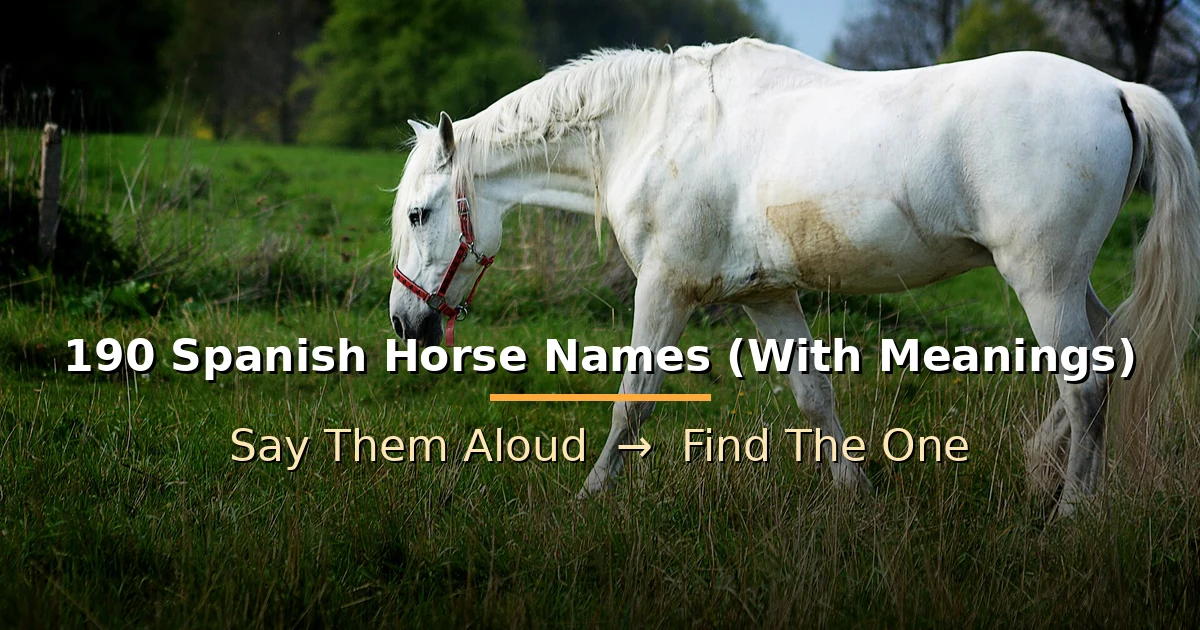
In 1567, King Philip II of Spain laid down formal rules for breeding the horses of his kingdom — the beginning of the Pura Raza Española, the Pure Spanish Horse. Nearly 460 years later, the Andalusian is still recognised as a distinct breed, just as it has been since the 15th century, and more than 185,000 Andalusians were registered around the world by 2010. The names below come from that same long story: 190 Spanish horse names, each with its real meaning, sorted by how they sound — short and punchy, long and melodic, fiery, gentle, place-born, saintly, and famous. Of the 190, thirty are built for bold horses, thirty for gentle ones, and thirty come from real Spanish places, rivers and festivals.
Spanish horse names suit any breed, not just Andalusians. They sound warm across a field, they look beautiful on a show entry, and most mean something lovely — moon, brave, star, free. The mustang’s story even begins with Spanish horses brought to the Americas in the 1500s, which is why so many of our mustang horse names have Spanish roots too. And if you want the big picture first, our horse names A to Z hub gathers the best names from every letter guide on this site.
How Spanish Names Sound
Before you pick a name, say it the Spanish way. Three things make Spanish names ring out across a yard.
Roll the R. The Spanish R is a trill, made by tapping the tongue against the roof of the mouth — try it on the word correr (to run) before you try it on a name. A rolled R is the single fastest way to make a name sound Spanish instead of borrowed.
Say every vowel. Spanish has five pure vowel sounds — a, e, i, o, u — and each one is always said the same way. There are no silent letters and no swallowed syllables, which is why a name like Luna sounds exactly like it looks. The stress usually falls on the second-to-last syllable, so es-TRE-lla, va-LIEN-te.
Watch the -o and -a endings. Most Spanish words ending in -o are masculine and most ending in -a are feminine — bonito for a handsome colt, bonita for a pretty mare. That one letter is the easiest gender test in naming: if the ending feels wrong for your horse, flip it. Accent marks (á, é, í, ó, ú) tell you which syllable takes the stress, and the ñ is its own letter, said like the “ny” in “canyon.”
Short & Punchy Spanish Horse Names
One or two syllables is all a yard name needs. These carry over wind and distance, and they are the easiest for a horse to learn. Short names work the same way on a working ranch, as our ranch horse names guide shows.
- Rey – king. The short, royal call every rider dreams of.
- Sol – sun. Bright, warm, and easy to shout across a field.
- Luna – moon. The most-loved Spanish horse name of all.
- Mar – sea. Calm and deep, like a horse that never panics.
- Paz – peace. For the calm horse everyone loves.
- Luz – light. For the horse that brightens the yard.
- Flor – flower. Short, soft, and lovely to say.
- Río – river. Smooth, strong and always moving.
- Oro – gold. Perfect for a palomino or chestnut.
- Voz – voice. For the horse that always lets you know.
- León – lion. Brave-hearted and proud.
- Toro – bull. Power and presence in one word.
- Rosa – rose. Classic, gentle and easy to love.
- Alba – dawn. For the horse that wakes the yard.
- Nieve – snow. Pure white in every way.
- Brisa – breeze. Light, quick and hard to catch.
- Perla – pearl. Small, precious and white.
- Jade – jade. A jewel of a name for a green-eyed horse.
- Cielo – sky. Wide, calm and full of light.
- Fuego – fire. For the hot-blooded horse.
- Rayo – lightning, a flash of light. Fast and electric.
- Trueno – thunder. Big, loud and bold.
- Viento – wind. Wild and free-spirited.
- Lobo – wolf. Clever, loyal and wild at heart.
- Puma – puma. Quick and powerful.
- Zorro – fox. Sly, quick and charming.
- Gala – party, celebration. For the show-off.
- Noche – night. Dark, calm and mysterious.
- Coral – coral. Warm pink, quick and bright.
- Vega – meadow, plain. Open, calm and free.
Long & Melodic Spanish Horse Names
Some Spanish names are songs in themselves — three or four syllables that roll like a flamenco guitar. These suit the dressage horse, the show horse, and any horse whose trot has rhythm. Register the full name, and keep a short half for the yard.
- Estrella – star. For the horse that shines in the arena.
- Mariposa – butterfly. Delicate and graceful in the air.
- Melodía – melody. For a horse that moves with rhythm.
- Armonía – harmony. Calm, balanced and easy.
- Esperanza – hope. For the horse that came back from the edge.
- Amanecer – dawn. A name for a new beginning.
- Atardecer – sunset. Warm, golden and slow.
- Valiente – brave, valiant. Never flinches.
- Guerrero – warrior. Strong and fearless.
- Caballero – gentleman, knight, and literally “horseman.”
- Azucena – madonna lily. Pure white elegance.
- Margarita – daisy. Bright, cheerful and Spanish at heart.
- Violeta – violet. Quiet beauty in one word.
- Lucía – light. Brightens the whole barn.
- Serena – serene, calm. Nothing rattles her.
- Dulzura – sweetness. Gentle from nose to tail.
- Cariño – affection, darling. A name said with love.
- Encanto – charm. The horse everyone falls for.
- Fortuna – fortune, good luck. For the lucky one.
- Alegría – joy, happiness. Pure sunshine on four legs.
- Victoria – victory. For the horse born to win.
- Sinfonía – symphony. For a mover with perfect rhythm.
- Cadencia – cadence, rhythm. The dressage horse’s name.
- Rapsodia – rhapsody. Wild, beautiful and free.
- Sonora – sonorous, resonant. A name that rings out.
- Ondina – water-nymph, little wave. Graceful and cool.
- Celeste – heavenly. Soft, high and lovely.
- Aurora – dawn. Fresh light on a new day.
- Corazón – heart. The biggest heart in the barn.
- Tesoro – treasure. Precious in every way.
Fiery & Bold Spanish Horse Names
For the bold ones — the horse that pins its ears at the trailer and charges the jumps. These names carry heat, thunder and pride.
- Bravo – brave, fierce. Short and loud.
- Diablo – devil. The lovable troublemaker.
- Relámpago – lightning bolt. Pure speed.
- Tormenta – storm. Wild, powerful and impossible to ignore.
- Salvaje – wild. The untamed spirit.
- Libre – free. Born to run.
- Indomable – untamable. Nobody quite owns it.
- Audaz – bold, daring. Jumps first, thinks second.
- Fiero – fierce, proud. Head held high.
- Temerario – daring, reckless. Goes where others won’t.
- Triunfo – triumph. Every ride feels like one.
- Gloria – glory. Grand, unforgettable and loud.
- Coraje – courage. Heart bigger than its body.
- Poder – power. Muscle in a single word.
- Lucha – fight, struggle. Never gives up.
- Furia – fury. Controlled fire in horse form.
- Centauro – centaur, the mythical half-horse. Clever and grand.
- Pegaso – Pegasus, the winged horse of legend. For more mythic names see our Greek horse names guide.
- Conquistador – conqueror. Takes every trail it meets.
- Capitán – captain. Leads the herd.
- Jefe – boss, chief. Everyone follows him.
- Gigante – giant. For the big-boned boy.
- Coloso – colossus. Larger than life.
- Titán – titan. Mythic strength.
- Héroe – hero. Saves every ride.
- Campeón – champion. Born to win.
- Jinete – rider, horseman. The partner’s name.
- Noble – noble. Honourable in any language.
- Hidalgo – nobleman. Dignified and honourable.
- Príncipe – prince. Royalty in the making.
Gentle & Romantic Spanish Horse Names
Soft-eyed, kind-hearted, patient — these fit the mare who nuzzles your pocket for treats, and the gelding who stands still for the smallest rider. For more golden-coated ideas, our palomino horse names guide is full of them.
- Dulce – sweet. The kindest Spanish word there is.
- Bonita – pretty. Simple and true.
- Paloma – dove. Peaceful and gentle.
- Jazmín – jasmine. Sweet flower, sweet mare.
- Clara – clear, bright. Honest and open.
- Suave – soft, gentle. Velvet in horse form.
- Tierna – tender, loving. Soft-hearted through and through.
- Querida – beloved, dear.
- Amada – loved. Heart of the herd.
- Preciosa – precious, beautiful.
- Hermosa – beautiful. Classic and warm.
- Linda – pretty, cute. Friendly, always.
- Guapa – good-looking. Said with a smile.
- Consuelo – comfort, consolation. Calms everyone down.
- Clavel – carnation, Spain’s national flower.
- Lucero – bright star, the morning star.
- Nube – cloud. Soft, drifting and dreamy.
- Sueño – dream. For the wished-for foal.
- Vida – life. Full of it.
- Alma – soul. For the horse with depth.
- Amor – love. The simplest reason of all.
- Gracia – grace. Elegant in every step.
- Lluvia – rain. Soft and fresh.
- Duna – dune. Soft desert gold.
- Arena – sand. The pale dun coat.
- Tierra – earth. Grounded and natural.
- Rocío – dew. Fresh and delicate, made for mornings.
- Canela – cinnamon. Warm red-brown spice.
- Miel – honey. Sweet golden brown.
- Café – coffee. Rich, dark brown.
Spanish Place & Heritage Names
Spain’s cities, rivers and festivals make wonderful names — each one carries a real story. Jerez is home to the Royal Andalusian School of Equestrian Art, where the famous dancing horses train, and the Andalusian shares its baroque blood with the Friesian, the other great black-coated breed of old Europe — see our Friesian horse names guide for that side of the family.
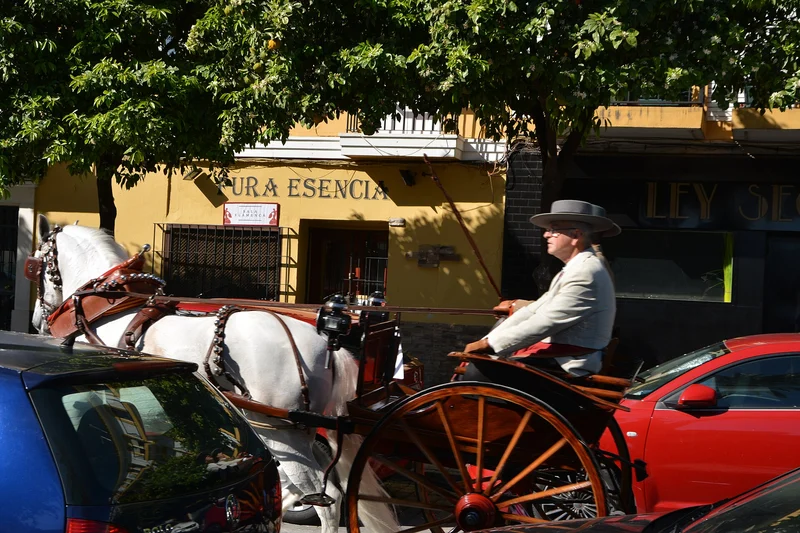
- Córdoba – the Andalusian city of horses and horsemen.
- Sevilla – Seville, home of flamenco and spring festivals.
- Granada – the Moorish jewel of Andalusia.
- Valencia – the sunny east-coast city of oranges.
- Aragón – the old Spanish kingdom. Strong and historic.
- Castilla – Castile, the heart of old Spain.
- Andalucía – the horse region itself. Where it all began.
- Jerez – Jerez de la Frontera, cradle of the Andalusian horse.
- Toledo – the old imperial city on the hill.
- Segovia – the Roman-aqueduct city. Ancient and proud.
- Ronda – the cliff-top town with Spain’s oldest bullring.
- Salamanca – the golden university city.
- Barcelona – the vibrant Catalan capital by the sea.
- Madrid – the capital. Big-city confidence.
- Mallorca – the sunny island. Easygoing and bright.
- Ibiza – the island of energy and rhythm.
- Duero – the great river of northern Spain. Steady and deep.
- Ebro – Spain’s longest river. Big and unstoppable.
- Tajo – the Tagus, the river of Toledo and Lisbon.
- Guadalquivir – the great river of Andalusia, of Seville and Córdoba.
- Guadiana – the river that runs through Extremadura.
- Miño – the river of Galicia in the green north.
- Pirineos – the Pyrenees, the mountain wall of Spain.
- Picos – the Picos de Europa. Tall, sharp and wild.
- Alhambra – the palace of Granada. Beautiful and historic.
- Mezquita – the great mosque-cathedral of Córdoba.
- Giralda – the bell-tower of Seville cathedral.
- Feria – the fair, the festival. Seville’s spring festival.
- Romería – the pilgrimage festival, with horses and flowers.
- Cartuja – the Carthusian monastery, home of the Cartujano horses.
Saints & Classic Spanish Names
In Spain, horses often carry classic human names — and they wear them well. These are the names you hear in every Spanish village, on saints’ days and family trees, and they suit a horse with an old soul. The Arabian is the other ancient breed whose names travel far beyond their homeland — see our Arabian horse names guide.
- Diego – a timeless Spanish classic, strong and steady.
- Carmen – song. Fiery, famous, unforgettable.
- Pablo – small. Big personality in a short name.
- Miguel – “who is like God.” A strong, traditional pick.
- Elena – shining light. Graceful and bright.
- Alejandro – defender of men. Grand for a big gelding.
- Isabel – devoted to God. Regal and timeless.
- Fernando – bold voyager. The adventurer’s horse.
- Sofía – wisdom. For the thoughtful, clever mare.
- Javier – new house. Noble and grounded.
- Rafael – God has healed. The comeback horse’s name.
- Teresa – harvester. Earthy and kind.
- Manuel – God is with us. Steady and reliable.
- Pilar – pillar. The strong support of the barn.
- Emilio – eager, rival. Spirited and keen.
- Antonio – priceless. Worth more than gold.
- Beatriz – bringer of joy. She delivers.
- Andrés – manly, brave. Solid and dependable.
- María – a classic Spanish name, beloved for generations.
- José – God will add. Steady and traditional.
- Carlos – free man. Independent and proud.
- Juan – God is gracious. Warm and classic.
- Pedro – rock. Solid and dependable.
- Luis – famous warrior. Brave and well-loved.
- Jorge – farmer. Earthy and grounded.
- Marta – lady. Dignified and kind.
- Sara – princess. Gentle and graceful.
- Laura – laurel. Honour and victory in one word.
- Paula – small. Petite and full of charm.
- Andrea – brave. Works beautifully for mares and geldings.
Famous Spanish Horses Worth Naming After
Real Spanish horses have already done the naming work for you. These are the ones that carried Spain’s name into Olympic arenas, war and literature — and for more legends from every breed, see our famous horse names guide.
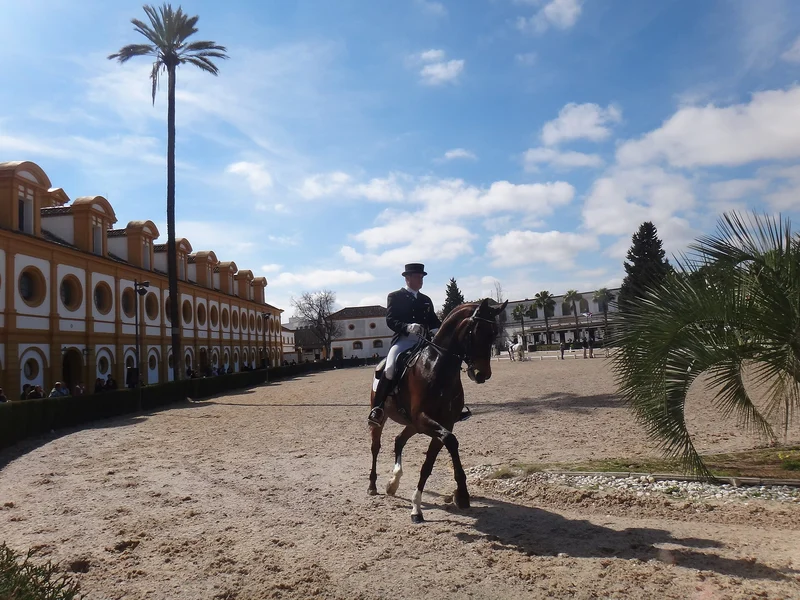
- Babieca – El Cid’s warhorse of the 11th century, the most famous Spanish horse in history.
- Evento – the first Olympic PRE, who carried Spain at the Athens Games in 2004.
- Invasor – Rafael Soto’s great dressage partner for over a decade.
- Fuego de Cárdenas – starred in one of the best freestyle performances ever ridden, at the 2010 World Equestrian Games.
- Oleaje – Ignacio Rambla’s Olympic PRE, who carried Spain at the Athens Games in 2004.
- Granadero – a PRE on the Spanish team at the 2002 World Equestrian Games in Jerez, ridden by Ignacio Rambla.
- Distinguido – another celebrated PRE dressage horse of the same golden generation.
- Grandioso III – a modern PRE dressage name honoured among the great Spanish horses at the Iberian Cup.
- Rocinante – Don Quixote’s horse in Cervantes’s classic novel — fictional, but no Spanish horse name carries more story.
- El Morzillo – Hernán Cortés’s horse, remembered in the history of the Spanish conquest of the Americas.
My Top 10 Shortlist
One hundred and ninety names is a lot to hold in your head, so here is where I would start. Say each of these ten aloud — across the yard, in the stable, and like a show announcer — and keep the one that fits your horse best.
If none of the ten feels right, go back to the section that matches your horse’s sound — short, melodic, fiery or gentle — and read that list aloud instead. The right name is usually the one you say twice without thinking.
- Luna – the moon. If your horse is calm, pale-coated or simply beloved, start here.
- Valiente – brave. The name for a horse that never flinches.
- Estrella – star. For the one that shines in the arena.
- Rayo – lightning. Short, electric, impossible to forget.
- Carmen – song. Fiery, famous, and full of rhythm.
- Diego – the timeless classic. Strong, steady, suits any horse.
- Paloma – dove. For the gentlest mare in the barn.
- Jerez – the cradle of the Andalusian. Heritage in one word.
- Fuego – fire. For the hot-blooded one with energy to burn.
- Babieca – El Cid’s horse. The name with the deepest Spanish story.
Spanish Horse Names: FAQs
How do you pronounce Spanish horse names?
Say every letter — Spanish has no silent letters — and give each vowel its pure sound: a, e, i, o, u. Roll the R by tapping your tongue against the roof of your mouth, and put the stress on the second-to-last syllable in most names: es-TRE-lla, va-LIEN-te. Accent marks show you the stressed syllable, so Lu-CÍ-a and Cór-do-ba are said exactly as written.
Are Spanish horse names gendered?
Usually, yes — and the ending tells you. Names ending in -o are mostly masculine (Diego, Pablo) and names ending in -a are mostly feminine (Luna, Paloma). Many word-names work for either sex, though: Valiente, Libre and Salvaje suit a mare or a stallion equally well. If an ending feels wrong for your horse, flip it — bonito becomes bonita, dorado becomes dorada.
Should I keep the accent marks in my horse’s name?
Keep them on the stable door and the show entry, where they show the correct pronunciation — Córdoba, Lucía, Sevilla. Most registries and yard boards handle accents fine today. If a form or a system strips them, the name still works: Cordoba and Lucia are the same name without the mark, just said with a little less guidance.
Do Spanish names only suit Andalusians?
No. They are a natural fit for Andalusians and other Iberian breeds, but Spanish names suit any horse — the meanings are universal: moon, brave, star, free. Grey is the most common Andalusian coat colour, so a Spanish name on a grey of any breed feels right at home. The mustang’s story even starts with Spanish horses, which is why Spanish words run through that breed’s naming too.
What is the most popular Spanish horse name?
There is no official ranking, but Luna is by far the most widely used Spanish horse name — it works for any breed, any colour, and either sex. Diego, Carmen and Valiente are the next most common names you will hear called across a yard.
What Spanish horse name means “brave”?
Valiente means brave or valiant, and Bravo means brave or fierce. Valiente works for either sex, while Guerrero means warrior and Guerrera is its feminine form. For a shorter call across the field, Bravo is the one-syllable answer.
Which real Spanish horses are famous enough to name after?
Babieca, El Cid’s 11th-century warhorse, is the most famous Spanish horse in history. In modern sport, Evento was the first Olympic PRE, Invasor was Rafael Soto’s great dressage partner for over a decade, and Fuego de Cárdenas starred in one of the best freestyles ever ridden at the 2010 World Equestrian Games. Rocinante, Don Quixote’s horse, is the famous fictional one.
Photo credits: Featured photo: Andalusian horse by Katrina Swinnley, CC BY-SA 4.0, via Wikimedia Commons. In-article photos are credited under each image.

Hi, I’m Liam
I run Pet Names Lovers — every guide here starts from a question I’d want answered myself, researched properly, and written in plain English. I write, edit, and publish everything myself.
12 thoughts on “Spanish Horse Names”